
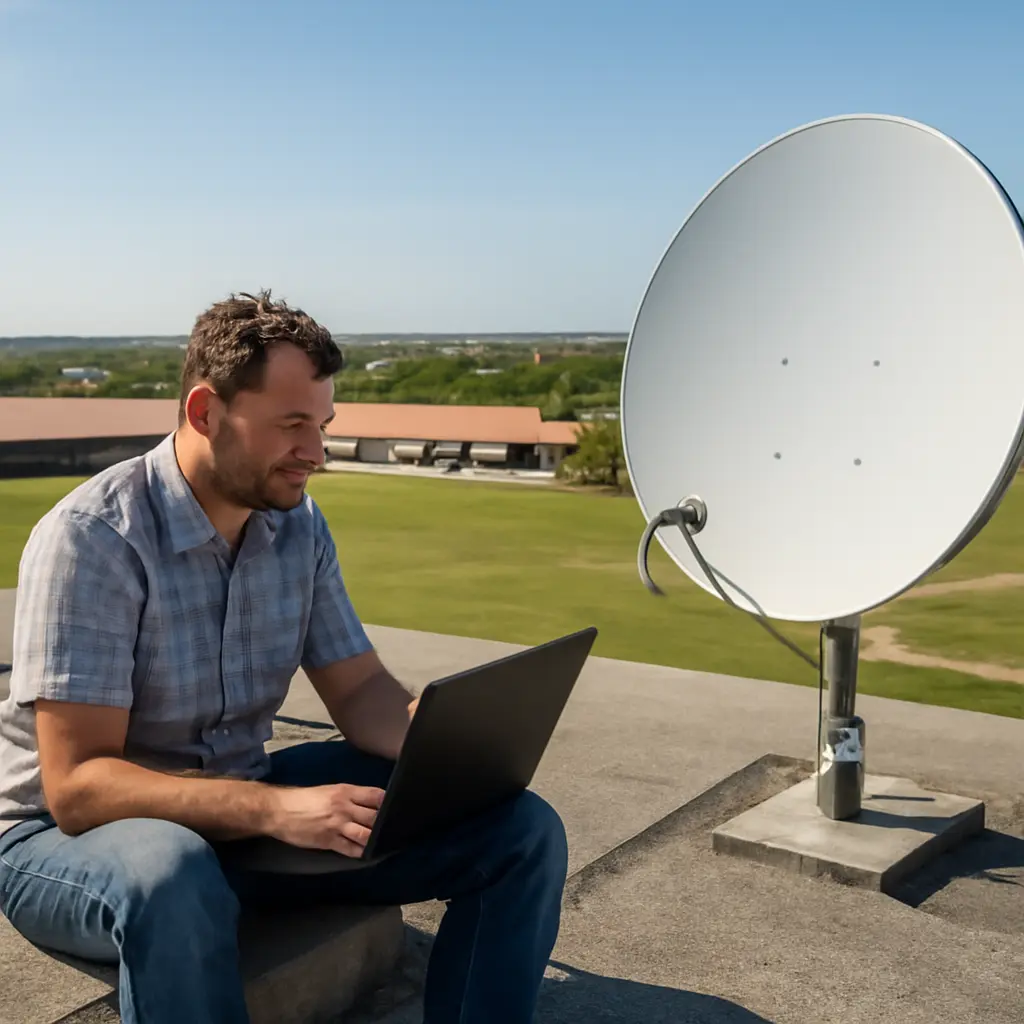
Rural schools use satellite broadband to connect students beyond the school building: they bring internet access to remote campuses, support learning when students are at home, and link teachers with online lessons and services. Satellite service can reach places where wired networks are absent or costly to extend, but real-world results depend on affordability, installation, weather, network capacity, and whether families have devices and reliable indoor Wi-Fi. The examples and federal data below show how schools use satellite links, what the technology can and cannot do, and how to assess whether it is helping students.
Satellite broadband connects rural schools and students
Satellite broadband is internet service delivered through a communications satellite and a ground terminal, rather than through a cable or fiber connection running to the premises. The Federal Communications Commission (FCC) treats satellite as one of several fixed broadband technologies; the practical distinction for rural schools is that a satellite signal can reach locations where terrestrial infrastructure is sparse or difficult to build.
Schools use satellite in several ways: as the primary connection for an isolated campus, as a backup link when terrestrial service fails, and as a means of extending learning beyond school grounds. The value is especially clear where students would otherwise have limited access to assignments, digital textbooks, video instruction, or communication with teachers. But a connection at school does not automatically solve the home-access problem: students still need an affordable device, suitable service, and a usable connection at home.
The scale of the challenge is substantial. The FCC’s 2024 Broadband Progress Report estimated that 24 million people in the United States lacked access to fixed broadband meeting its benchmark of 100 Mbps download and 20 Mbps upload, including 28% of people in rural areas. These are population estimates, not a count of unconnected students, but they show why schools in remote communities continue to consider satellite alongside fiber, fixed wireless, and cellular options.
School satellite broadband serves several distinct roles
The National Center for Education Statistics (NCES) describes school internet access through measures such as connection type, speed, and availability. In practice, “satellite broadband for schools” is not a single model: schools choose different arrangements according to geography, budgets, and whether the immediate goal is to connect a campus, a household, or a mobile learning site.
Primary connectivity for a remote campus
A primary satellite connection provides a school’s main path to the internet when fiber, cable, or terrestrial fixed wireless is unavailable. The school can use it for cloud-based learning platforms, digital research, attendance and administrative systems, and communication with families. A campus may also distribute the connection over its local network to classrooms, libraries, and student devices.
The bottleneck is often not whether a satellite signal reaches the building, but how much capacity is available to share. A school with many simultaneous users may need a business-grade plan, carefully managed Wi-Fi, and traffic prioritization for essential applications. Video conferencing and large downloads can consume substantial capacity, so educators may schedule downloads in advance or provide lower-bandwidth alternatives.
Backup connectivity and network resilience
Some schools use satellite as a secondary connection that takes over if the primary line is cut, overloaded, or disrupted by severe weather. This arrangement can keep essential services—such as school communications, enrollment systems, and access to instructional materials—available during an outage. Whether backup works automatically depends on network equipment and configuration; a satellite terminal alone does not guarantee failover.
Redundancy is particularly relevant in communities with a single terrestrial provider or long repair times. Administrators should test failover, confirm which applications will remain usable, and budget for the second connection and equipment. Satellite can diversify the route into a school, although local power failures, damaged terminals, or severe weather may affect service too.
Home access and take-home learning
For students who live beyond the school’s wired footprint, satellite can be one option for household internet, often arranged through a family subscription, a community program, or a school-supported initiative. Schools may pair connectivity with loaner laptops, printed materials, offline lesson downloads, or access to a connected community location. This matters because assigning online work does not ensure that every student can complete it at home.
The pandemic made the homework-access gap more visible, but the problem predates it. Pew Research Center reported in 2018 that 17% of U.S. teenagers said they were often or sometimes unable to complete homework because they lacked reliable access to a computer or internet connection. That national survey is not a current measure of rural satellite access, but it illustrates why school connectivity plans need to consider students’ homes as well as campus networks.
Classroom uses depend on bandwidth, latency, and reliability
Once a school is connected, satellite broadband supports many of the same activities as other internet services: learning-management systems, digital libraries, online assessments, remote tutoring, and communication with families. Its usefulness, however, varies by application. Downloading a reading assignment is less demanding than running several live video classes at once, while interactive tools can be sensitive to latency—the time it takes data to travel between a user and an online service.
Digital lessons, research, and learning platforms
Students and teachers use connected devices to access course materials, research databases, educational videos, and collaborative documents. Schools can reduce congestion by caching frequently used content locally, distributing large files outside peak hours, and choosing platforms that work on modest connections. These measures are useful with any constrained network, not only satellite.
Live instruction and remote specialist support
A satellite link can help a small rural school connect students to remote tutors, language instruction, advanced courses, or specialists who are not available locally. Live video is more demanding than text or recorded content: older geostationary satellite systems have higher latency, which can make conversation feel less immediate, while newer low-Earth-orbit services generally offer lower latency but still vary with network conditions, capacity, and location. Schools should pilot the specific service with the applications and number of users they expect to support.
Assessments, administration, and family communication
Broadband also supports online testing, student information systems, secure staff communications, and routine contact between schools and caregivers. These functions may be less visible than classroom video, but interruptions can delay essential school operations. Administrators should identify which services are time-critical, confirm that security and filtering policies work over the satellite connection, and maintain an offline procedure for outages.
Satellite service has practical limits schools must plan around
Satellite’s geographic reach is a major advantage, but reach alone is not a measure of educational quality. Service plans differ in speed, data allowances, contention, equipment costs, and installation requirements. Schools and districts should compare total cost of ownership—not only the monthly fee—including terminal hardware, mounting, networking equipment, support, and potential upgrades.
Latency, capacity, and peak-hour congestion
Latency affects the feel of interactive applications, while throughput determines how much data can move at once. Geostationary satellites orbit far from Earth, introducing more signal travel time than low-Earth-orbit systems; newer low-orbit networks can reduce that delay, though actual performance depends on the plan, local coverage, and network load. A school should test real classroom tasks at busy times rather than rely solely on advertised maximum speeds.
Weather, installation, and power
Heavy rain or snow can weaken satellite signals, and terminals need a suitable view of the sky. Buildings, trees, mounting conditions, and local weather therefore affect installation and reliability. Schools should inspect sites before purchase, arrange professional installation where needed, protect equipment and cables, and consider backup power for locations where outages are common.
Affordability, devices, and digital skills
A broadband connection is only one part of access. The U.S. Department of Education’s National Educational Technology Plan emphasizes that the digital divide includes gaps in access to devices, connectivity, and meaningful opportunities to use technology. Schools may need to combine service with device lending, technical help, accessible learning materials, and guidance for families. Without these supports, a technically connected student can still be excluded from online learning.
Funding and evaluation shape whether school connections last
Districts often assemble funding from school budgets, state or federal programs, and community partnerships. The FCC’s E-Rate program helps eligible schools and libraries obtain discounts on telecommunications and internet services, subject to program rules and competitive bidding. E-Rate support can make connectivity more affordable, but districts should verify eligibility and applicable requirements before selecting a service or equipment.
The best evaluation asks whether the connection improves access to instruction, not just whether the terminal is online. Schools can track connection uptime, measured speeds during school hours, the number of students able to complete digital work, support requests, and the cost per connected site or household. They should also gather feedback from teachers and families, then adjust plans when service limitations interfere with learning.
A practical checklist for rural districts
- Map which campuses and student households lack adequate service, and compare satellite with fiber, fixed wireless, and cellular alternatives.
- Test the proposed connection using actual learning platforms, video lessons, and expected numbers of simultaneous users.
- Calculate installation, equipment, service, support, and replacement costs over the full contract period.
- Pair connectivity with devices, accessible content, cybersecurity protections, and family support.
- Plan for weather and power interruptions, and maintain offline materials and backup procedures.
- Review performance and student access regularly rather than treating installation as the finish line.
Conclusion: satellite broadband is a bridge, not a complete solution
Rural schools use satellite broadband as a primary campus connection, an outage backup, and—where programs and affordability allow—a route to learning at home. It can expand access to digital lessons, remote specialists, school services, and family communication in places that terrestrial networks do not readily reach. At the same time, latency, congestion, weather, price, devices, and home connectivity shape what students can actually do with the service.
For school leaders, the next step is to map unmet needs, compare technologies, test performance in real teaching conditions, and budget for devices and ongoing support. For families and communities, asking whether students can reliably use the connection—not simply whether a satellite terminal has been installed—is the key measure of progress.
Sources: Federal Communications Commission, 2024 Broadband Progress Report, https://www.fcc.gov/reports-research/reports/broadband-progress-reports/2024-broadband-progress-report; National Center for Education Statistics, Internet Access in U.S. Public Schools and Classrooms: 1994–2005, https://nces.ed.gov/pubs2007/2007020.pdf; Pew Research Center, Nearly one-in-five teens can’t always finish their homework because of the digital divide, https://www.pewresearch.org/short-reads/2018/10/26/nearly-one-in-five-teens-cant-always-finish-their-homework-because-of-the-digital-divide/; U.S. Department of Education, 2024 National Educational Technology Plan, https://tech.ed.gov/netp/; Federal Communications Commission, E-Rate: Universal Service Program for Schools and Libraries, https://www.fcc.gov/general/e-rate-schools-libraries-usf-program