
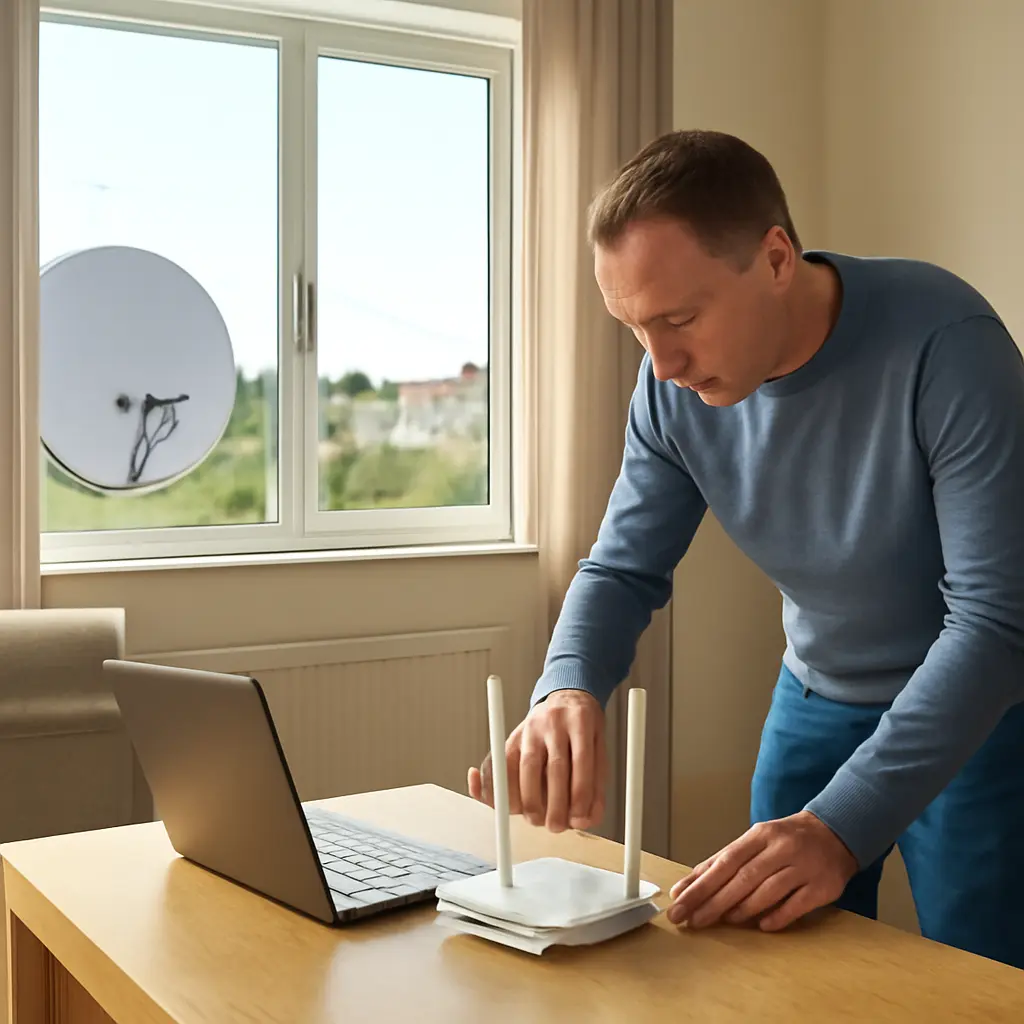
Residential satellite internet can connect many people through one terminal, but it cannot give every household unlimited high-speed capacity at the same time. The practical limit depends on how much spectrum and network capacity serve a coverage area, how providers schedule traffic, and whether demand peaks together. Starlink’s filings describe a low-Earth-orbit system designed for large numbers of user terminals, while Ookla speed-test data have shown that performance varies by country and over time as networks and subscriber loads change. Understanding shared capacity, congestion, service tiers, and household Wi-Fi helps explain why advertised speeds are not a guarantee of simultaneous performance—and what customers can do about it.
Shared capacity defines residential satellite network performance
A satellite network’s simultaneous-user capacity is the amount of traffic it can carry for users who are active at the same time within a particular service area and period. It is not simply the number of customers a satellite can “support”: users consume different amounts of bandwidth, demand rises and falls, and capacity is shared across radio cells, satellites, gateways, and terrestrial backhaul. The Federal Communications Commission (FCC) explains that broadband performance depends on factors including network congestion, the user’s connection, and the services being accessed.
This makes “how many users can connect?” a less useful question than “how much busy-hour traffic can the network reliably serve, and how is that capacity allocated?” A connected device may be idle, while a single household streaming high-resolution video, downloading a game, or backing up cloud files can use substantial capacity. Satellite operators therefore engineer for statistical sharing: not every subscriber is expected to use their maximum plan speed continuously.
Coverage area and capacity are not the same thing
Coverage describes where service is available; capacity describes how much traffic can be handled there. A satellite beam or cell may cover a broad region, but the available radio spectrum and network equipment place limits on its total throughput. When many users in that same area are active together, each may receive less capacity even though their signal remains strong.
This distinction is especially important for low-Earth-orbit (LEO) systems. Satellites move rapidly relative to the ground, and user terminals may be served by different satellites over time. Handoffs can change the path serving a customer, but they do not eliminate the underlying limits of spectrum, satellite capacity, gateway links, or local demand.
Busy-hour demand exposes the shared-resource trade-off
The busy hour is the period when a network experiences its highest sustained demand, commonly in the evening for residential service. Providers use traffic management and capacity planning to balance demand across users. As a result, advertised plan speeds and short speed-test peaks should not be interpreted as guaranteed speeds for every subscriber at every hour.
Ookla’s Speedtest Intelligence reports have documented changes in median Starlink download speeds across countries and quarters, illustrating that real-world results can shift as network capacity, subscriber numbers, and usage patterns evolve. Such measurements are useful snapshots, not a universal promise: results depend on location, test conditions, plan, and the specific period measured.
Satellite orbit and network design shape simultaneous-user capacity
The main residential satellite network types are geostationary orbit (GEO), medium-Earth orbit (MEO), and low-Earth orbit (LEO). Their differences in altitude, latency, satellite movement, and architecture affect how service is delivered, but none makes capacity infinite. The FCC’s broadband materials distinguish satellite service as a technology whose performance characteristics differ from fixed terrestrial connections, while operator filings describe the spectrum, satellites, and ground infrastructure needed to deliver service.
GEO satellites serve wide areas with higher latency
Geostationary satellites orbit at approximately 35,786 kilometers above Earth and appear fixed over one point on the equator. Their high altitude enables broad coverage from a single satellite, but the long signal path contributes to higher latency than LEO systems. This can affect interactive activities such as video calls and online gaming, even when throughput is sufficient.
Wide coverage does not mean unlimited simultaneous throughput. GEO capacity is still divided among beams and users, and congested beams can experience slower speeds during busy periods. The relevant unit is the capacity available in the user’s beam and service area, not the satellite’s total theoretical throughput across its entire footprint.
LEO constellations reduce delay but still share spectrum
LEO satellites orbit much closer to Earth than GEO satellites, reducing signal travel time and enabling lower-latency service. Starlink’s FCC filings describe a constellation operating in multiple orbital shells and using inter-satellite links and ground gateways as parts of its network architecture. The constellation’s scale can improve coverage and provide more opportunities to route traffic, but each satellite and cell still has finite radio and processing resources.
A larger constellation can help distribute traffic and improve resilience, but total user experience also depends on how many customers are concentrated in a region, available spectrum, gateway access, and backhaul. Thus, satellite count alone does not establish how many households can simultaneously receive a particular speed.
Spectrum and gateways create practical bottlenecks
Spectrum is the radio-frequency resource used to transmit data between user terminals, satellites, and ground stations. Because radio spectrum is finite and subject to licensing and interference constraints, operators must reuse frequencies carefully across beams and cells. A network may also be constrained when traffic reaches a gateway or terrestrial connection with insufficient capacity.
The National Academies’ work on broadband infrastructure emphasizes that network performance depends on interconnected components rather than a single link. For satellite broadband, a strong terminal-to-satellite signal cannot compensate for a congested satellite beam, gateway, or upstream network segment.
Traffic management determines how users share available capacity
Traffic management is the set of technical and policy measures providers use to allocate network resources when demand approaches available capacity. It may include prioritization, deprioritization, data thresholds, scheduling, or plan-based service classes. These practices influence how performance changes during congestion and which users are served first.
Priority tiers can change performance during congestion
A priority tier gives some traffic or subscribers precedence over others when network resources are constrained. In its residential service descriptions, Starlink has explained that network management may affect performance during periods of congestion and that service characteristics can vary by plan and location. Customers should therefore examine the current plan terms and local availability rather than assume all terminals receive identical treatment.
Priority does not create additional capacity; it changes how existing capacity is allocated. If a region is persistently overloaded, priority may improve one customer’s relative experience while leaving the total network throughput unchanged.
Data policies and heavy downloads affect shared use
Data policies may distinguish between priority and standard data, set thresholds, or manage unusually heavy usage. The exact rules can change, so customers should consult the provider’s current service terms. Large downloads, automatic software updates, cloud backups, and multiple concurrent video streams can raise household demand and contribute to congestion in a shared cell.
A household can reduce avoidable contention by scheduling large downloads outside peak hours, limiting automatic backups, and using router quality-of-service settings where available. These steps cannot increase satellite capacity, but they can help prioritize latency-sensitive activities such as calls over background transfers.
Speed tests measure moments, not guarantees
A speed test measures performance between a device and a test server at a particular time. Results can be affected by the test server, Wi-Fi conditions, the device, the service plan, and network load. The FCC’s broadband measurement resources distinguish advertised service from actual measured performance, reinforcing the value of repeated tests rather than relying on a single result.
For a more meaningful picture, test at different times—including the evening busy hour—and connect a computer to the router by Ethernet when possible. Record download speed, upload speed, and latency. If wired results remain poor while local Wi-Fi is strong, the issue may lie upstream in the satellite service or local network conditions rather than in the household wireless signal.
Household device counts can obscure the real bottleneck
“Simultaneous users” can mean subscribers sharing a satellite cell, people in one home, or devices connected to a router. These are different scales. A home router may support many connected devices, but the satellite connection still limits the household’s total internet throughput; conversely, a household may have fast satellite service but poor Wi-Fi coverage that makes individual devices appear slow.
Applications consume different amounts of bandwidth
The bandwidth required by a household depends on what its devices are doing. Email and ordinary web browsing usually use modest, intermittent traffic. High-definition and ultra-high-definition video, large downloads, video conferencing, and online backups can demand more sustained throughput. The number of devices alone therefore cannot predict performance without knowing the applications and activity patterns.
As a practical example, several people browsing and sending messages may share a connection comfortably, while two simultaneous 4K streams plus a large game download can create noticeable competition on a constrained connection. The exact result depends on compression, application settings, provider capacity, and current network load.
Wi-Fi interference can mimic satellite congestion
Wi-Fi is the local wireless link between a router and household devices; it is separate from the satellite link. Distance, walls, interference from neighboring networks, router placement, and device capability can all reduce Wi-Fi speeds. A slow phone in a distant room does not, by itself, prove that the satellite network is congested.
To isolate the cause, compare a wired speed test near the router with a wireless test in the problem area. If Ethernet performance is substantially better, improving router placement, adding a wired access point, or using a mesh system may help. If both wired and wireless tests fall at the same busy times, upstream congestion is more plausible.
Real-world evidence shows why capacity must be assessed locally
National and global averages can conceal major local differences. Satellite performance depends on the relationship between capacity and demand in a particular cell, so a rural region with relatively few active terminals may behave differently from a popular service area with concentrated demand. This is why availability, measured speeds, and provider disclosures should be evaluated at the address level whenever possible.
Ookla speed-test trends are useful but limited evidence
Ookla’s quarterly Speedtest Intelligence analyses have tracked Starlink median performance across markets. Their findings show that measured speeds can change as the service expands and networks are upgraded, but a median is not a guarantee for an individual household. It also does not reveal every cause of a change: demand, infrastructure, testing mix, and plan availability can all contribute.
For consumers, the best use of these reports is comparative: they can indicate broad trends and differences among markets. For a purchase decision, local customer experience, service terms, and repeated tests at the intended address are more directly relevant.
Provider filings describe architecture, not household guarantees
FCC licensing and authorization filings provide technical information about satellite systems, including operating frequencies, orbital parameters, and proposed network configurations. They help explain how a constellation is designed, but they are not equivalent to a promise that every subscriber will receive a fixed speed during peak demand.
A useful consumer assessment combines several kinds of evidence: the provider’s plan terms, local availability and capacity notices, independent measurement data, and the household’s own wired tests. Together, these sources offer a more realistic picture than a headline speed or a satellite-count figure alone.
Conclusion: judge satellite service by busy-hour capacity, not headline speed
Residential satellite networks are shared systems, and simultaneous-user performance depends on local capacity, spectrum, gateways, orbital design, traffic management, and the timing and intensity of demand. GEO, MEO, and LEO architectures differ in coverage and latency, but each faces finite-resource constraints. Priority policies can affect who gets served first, while household applications and Wi-Fi conditions determine how available service is experienced at home.
Before choosing a plan, check current service terms and local availability, ask how congestion and priority data are handled, and compare wired speed tests at peak and off-peak times. For broader understanding, consult FCC broadband measurement resources, independent Ookla trend reports, and the operator’s current filings and plan disclosures. A realistic busy-hour assessment is more useful than assuming every connected household can use its advertised maximum speed at once.
Sources: Federal Communications Commission, Measuring Broadband America, https://www.fcc.gov/general/measuring-broadband-america; Federal Communications Commission, Satellite Communications, https://www.fcc.gov/general/satellite-communications; Ookla, Speedtest Intelligence, https://www.speedtest.net/insights; Space Exploration Technologies Corp., FCC satellite system filings and applications, https://www.fcc.gov/space/space-station-applications; Starlink, Residential Service Plans and Policies, https://www.starlink.com/legal; National Academies of Sciences, Engineering, and Medicine, Broadband: Expanding Broadband Access to Rural America, https://nap.nationalacademies.org/catalog/259 en/broadband-expanding-broadband-access-to-rural-america.