
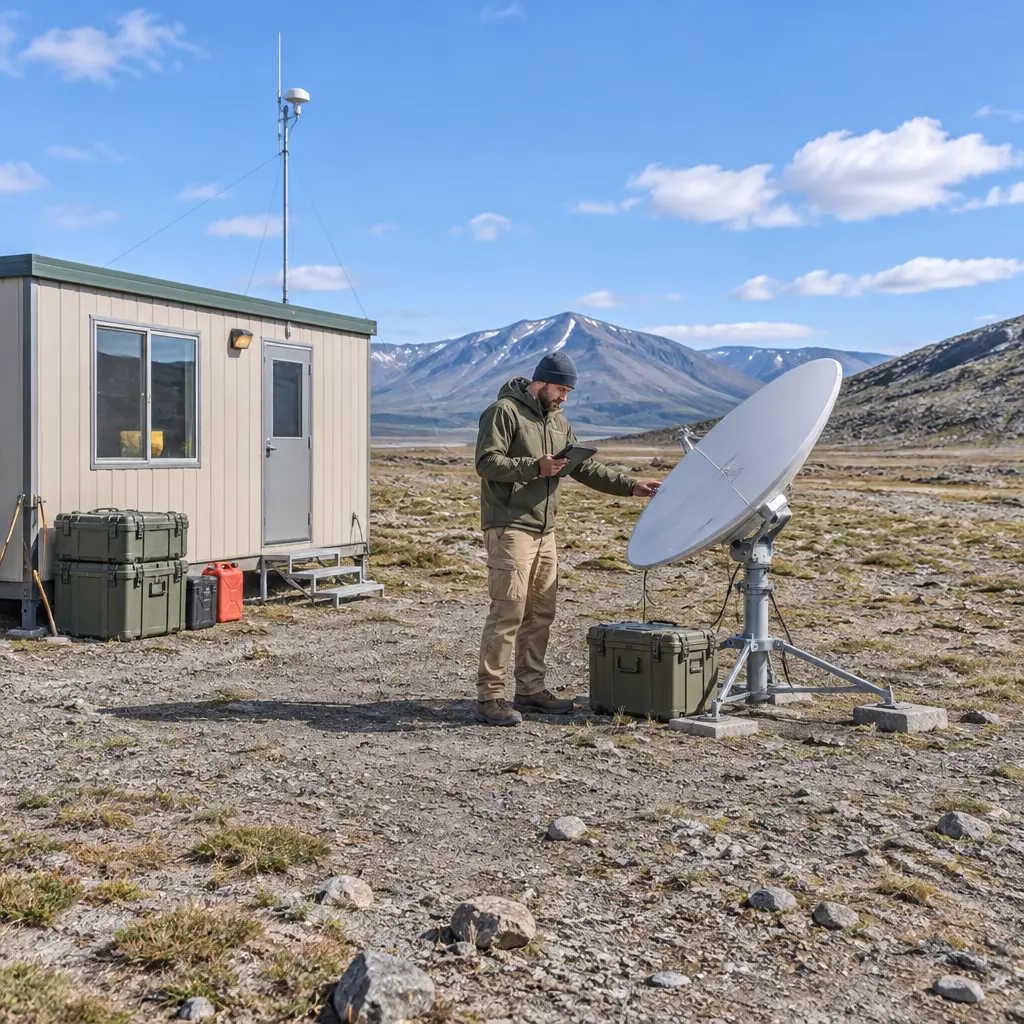
Satellite-primary business continuity planning uses satellite communications as the main connection for remote operations, rather than relying on terrestrial broadband or cellular networks. A resilient plan pairs that link with tested power, secure network design, service-level requirements, and a workable recovery option. This matters because outages can interrupt payments, dispatch, safety communications, and access to cloud systems; the U.S. Federal Communications Commission (FCC) reported that Hurricane Ian caused widespread communications outages in Florida in 2022, illustrating how terrestrial infrastructure can be disrupted by a regional disaster. The sections below define the planning model, compare satellite technologies, explain continuity controls, and outline deployment and testing practices.
Business Continuity Planning Defines Satellite-Primary Connectivity
Business continuity planning (BCP) is the coordinated process of preparing an organization to keep priority products and services operating during disruption and to recover them within acceptable timeframes. ISO 22301:2019, the international standard for business continuity management systems, frames this work around preparing for, responding to, and recovering from disruptive incidents. A satellite-primary design applies that planning discipline to connectivity: satellite is the normal operational path, while terrestrial service, a second satellite path, or another approved method may serve as contingency.
The design is not simply “install a dish and continue working.” It begins with a business impact analysis, identifies dependencies such as electricity and cloud authentication, and sets recovery time objectives (RTOs) and recovery point objectives (RPOs). The U.S. Cybersecurity and Infrastructure Security Agency (CISA) recommends that organizations plan for communications resilience, including redundant communications paths and regular exercises. Relevant BCP categories include operational continuity, IT disaster recovery, emergency communications, and supplier continuity; satellite connectivity supports all four but does not replace their wider procedures.
Business impact analysis and critical services
A business impact analysis identifies which activities must continue, how quickly they must resume, and what losses follow an interruption. For a remote mine, clinic, utility site, or field office, critical services may include dispatch, telemetry, point-of-sale transactions, remote diagnostics, and emergency calls. The analysis should classify traffic by business priority and estimate minimum bandwidth, acceptable latency, and maximum tolerable outage for each service. The Federal Emergency Management Agency’s Continuity Guidance Circular emphasizes identifying essential functions and their supporting resources before selecting continuity strategies.
Recovery objectives and service requirements
RTO is the target time to restore a service after disruption; RPO is the maximum acceptable period of data loss measured in time. Neither is a satellite performance statistic: both are business requirements used to choose service and architecture. A site that needs voice and messaging within minutes may tolerate a different link profile from one that must continuously synchronize industrial control data. Document throughput, latency, jitter, packet loss, availability, data caps, and restoration commitments in measurable terms, then confirm them through testing and provider agreements.
Satellite Connectivity Provides a Distinct Continuity Path
Satellite connectivity transmits data between a user terminal and a satellite network, then onward through ground infrastructure to the internet or a private network. Its continuity value comes from reducing dependence on local cable, fiber, and cellular access networks. The National Oceanic and Atmospheric Administration (NOAA) describes geostationary satellites as orbiting at about 35,786 kilometres above Earth, matching Earth’s rotation so they appear fixed over one region. Low Earth orbit (LEO) satellites operate much closer to Earth and move across the sky, requiring network handoffs or multiple satellites for continuous coverage.
The main satellite hyponyms in continuity planning are geostationary Earth orbit (GEO), medium Earth orbit (MEO), and LEO systems, along with fixed-site, transportable, and mobile terminals. These are not interchangeable. Orbit, spectrum, coverage, terminal design, congestion, weather sensitivity, and provider architecture all influence the service experienced at a particular site. The International Telecommunication Union (ITU) coordinates global radio-frequency and orbital-resource arrangements, while national regulators authorize services and equipment within their jurisdictions.
GEO links for stable fixed locations
GEO systems use satellites that appear stationary relative to a fixed antenna, making them suitable for many permanent remote sites and broadcast-style services. Their long distance introduces greater propagation delay than lower-orbit systems, which can affect interactive applications such as voice, remote desktop, and some control protocols. GEO may still be appropriate when coverage, established service plans, or fixed-terminal simplicity meet the operational requirement. Validate performance using the actual application and provider’s committed service characteristics rather than assuming all GEO services behave alike.
LEO and MEO links for lower-latency needs
LEO and MEO networks place satellites closer to Earth than GEO systems, generally reducing propagation distance, though actual latency and availability depend on network routing, satellite visibility, gateways, congestion, and service configuration. LEO services can suit interactive cloud tools and voice at locations beyond terrestrial reach, but may require unobstructed sky view and managed handoffs. MEO occupies an intermediate orbital region and is used in some broadband and enterprise networks. A buyer should test performance at the intended site and review coverage, capacity, service restrictions, and terminal power requirements.
Fixed, mobile, and deployable terminals
A fixed terminal is installed for a permanent location; a mobile terminal is designed to maintain service while moving or operating from vehicles, vessels, or aircraft where authorized; and a deployable terminal can be transported to a temporary worksite or recovery location. Each category has different installation, licensing, pointing, environmental, and power needs. For continuity, organizations should include spare cables and power supplies, secure mounting, trained operators, and a documented setup procedure—not just terminal hardware.
Satellite-Primary Resilience Depends on End-to-End Design
A satellite link is only one element in an end-to-end service chain. The terminal requires power, a clear radio path, functioning network equipment, a provider network, ground stations or gateways, and reachable applications. NIST Special Publication 800-34 Rev. 1 advises organizations to plan and test information-system contingency capabilities; applying that principle means assessing the full chain and its common failure points. Resilience improves when components do not share the same hazard, provider, power source, or physical route.
Power, environmental, and site resilience
Power continuity is essential because a satellite terminal, router, Wi-Fi access point, and connected equipment can all fail during a utility outage. Estimate the load and required runtime, then select an uninterruptible power supply, batteries, generator, solar-plus-storage system, or a tested combination. Protect equipment from heat, cold, moisture, lightning, corrosion, and physical damage according to manufacturer requirements. Site surveys should check sky visibility, structural mounting, cable routes, grounding, and safe access for maintenance.
Network security and traffic prioritization
A continuity link must preserve confidentiality, integrity, and access control as well as availability. Use managed firewalls, encryption, multifactor authentication, secure remote administration, patching, and network segmentation. CISA’s cybersecurity guidance stresses layered protections and incident preparation; the same controls should apply to satellite-connected sites. Quality-of-service policies can prioritize emergency voice, safety telemetry, and essential transactions over bulk updates or recreational traffic, while rate limits and offline modes help prevent limited capacity from being overwhelmed.
Weather, congestion, and provider dependencies
Heavy precipitation can attenuate satellite radio signals, particularly at higher frequencies, while obstructions, equipment faults, network congestion, and gateway or provider outages can also interrupt service. The magnitude of weather effects depends on frequency band, link design, location, and system controls; therefore, avoid applying a single generic availability figure to every site. Review the provider’s coverage maps, outage history where available, maintenance procedures, support escalation, data policies, and service-level agreement. Consider a second provider or different orbit only if it reduces shared dependencies in practice.
Continuity Controls Turn Satellite Access into an Operational Plan
The distinction between satellite as a primary link and satellite as a backup is operational: in a satellite-primary plan, staff, applications, monitoring, and support procedures are designed around normal satellite use. A terrestrial path may still provide diversity, but it should not be assumed to work unless it is independently provisioned and tested. Conversely, if the satellite link itself is the contingency path, the organization must maintain it in a ready state and validate activation time against its RTO.
Capacity planning and application readiness
Capacity planning translates essential business activity into network demand. Measure concurrent users, application bandwidth, peak periods, backup traffic, and synchronization patterns. Optimize applications for constrained or variable connectivity through caching, compression where appropriate, asynchronous synchronization, local data entry, and store-and-forward workflows. Define which functions can run offline and how conflicts are reconciled after reconnection. These measures reduce dependence on a continuously high-throughput link and make the continuity objective more achievable.
Supplier contracts and support arrangements
Provider selection should consider verified coverage, committed performance, support hours, repair and replacement processes, escalation contacts, cybersecurity responsibilities, service portability, and termination terms. Clarify whether advertised speeds are typical or guaranteed, how congestion is managed, whether data limits apply, and what remedies exist for service failure. For critical operations, identify alternate suppliers and compatible terminals in advance, but confirm that switching is technically and contractually feasible during a regional emergency.
Monitoring, exercises, and recovery procedures
Monitoring should track link availability, latency, packet loss, throughput, terminal status, power condition, and application health. Alerts need named owners and escalation paths. Exercise scenarios should include utility failure, terrestrial outage, obstructed antenna, severe weather, provider disruption, cyber incident, and loss of the normal worksite. FEMA continuity guidance supports regular testing, training, and exercises; record results, corrective actions, and retest dates so that procedures evolve with equipment and staffing changes.
Deployment Examples Show Where Satellite-Primary Planning Fits
Satellite-primary connectivity is most relevant where terrestrial access is unavailable, unreliable, costly to extend, or exposed to the same local hazards as the worksite. Examples include remote energy facilities, maritime operations, rural health services, construction camps, agricultural sites, and emergency response bases. It can also serve as a deliberate primary path where a business has assessed the trade-offs and designed applications around the service profile.
Remote industrial and utility sites
A remote industrial operator may use satellite for supervisory data, maintenance access, staff communications, and business applications while local control systems remain capable of safe operation if external connectivity fails. The continuity design should separate safety-critical control from general internet access, define safe degraded modes, and validate that remote access cannot bypass operational-technology security. This example illustrates why a communications plan must be coordinated with safety engineering and site emergency procedures.
Disaster response and temporary operations
After a disaster damages local infrastructure, portable satellite terminals can help establish communications at temporary command posts, shelters, or recovery sites, subject to coverage, power, and operational constraints. NOAA’s disaster-response materials describe the role of satellite observations in monitoring hazards, while the FCC’s post-Hurricane Ian reporting documents the scale of communications disruption that responders and communities may face. These examples support satellite’s role in resilience, but do not establish that any particular commercial service will remain available during every emergency.
Conclusion: Satellite-Primary Planning Requires Tested Resilience
Business continuity planning defines the services that must survive disruption; satellite connectivity supplies a distinct access path for remote operations; and end-to-end controls determine whether that path is dependable in practice. GEO, MEO, LEO, fixed, mobile, and deployable options have different characteristics, so selection should follow measured business requirements rather than marketing claims. Power, cybersecurity, capacity, weather exposure, provider dependencies, monitoring, and exercises all belong in the same continuity design.
Organizations considering satellite as a primary link should begin with a business impact analysis, document RTO and RPO targets, survey each site, and conduct a pilot under real operating conditions. Then test outage scenarios with staff and suppliers, correct identified gaps, and review the plan at least annually or after significant changes. Further reading should include ISO 22301, CISA continuity and communications-resilience guidance, FEMA continuity resources, and NIST contingency-planning guidance.
Sources: International Organization for Standardization, ISO 22301:2019 Security and resilience — Business continuity management systems — Requirements, https://www.iso.org/standard/75106.html; Federal Emergency Management Agency, Continuity Guidance Circular, https://www.fema.gov/emergency-managers/national-preparedness/continuity; Cybersecurity and Infrastructure Security Agency, Communications Resilience, https://www.cisa.gov/topics/critical-infrastructure-security-and-resilience/communications-resilience; Cybersecurity and Infrastructure Security Agency, Cybersecurity Performance Goals, https://www.cisa.gov/cross-sector-cybersecurity-performance-goals; National Institute of Standards and Technology, Contingency Planning Guide for Federal Information Systems, NIST SP 800-34 Rev. 1, https://csrc.nist.gov/pubs/sp/800/34/r1/upd1/final; National Oceanic and Atmospheric Administration, Geostationary Satellites, https://www.nesdis.noaa.gov/about/k-12-education/satellites/geostationary-satellites; International Telecommunication Union, Satellite Communications, https://www.itu.int/en/mediacentre/backgrounders/Pages/communications-satellites.aspx; Federal Communications Commission, Communications Status Report for Areas Impacted by Hurricane Ian, https://www.fcc.gov/ian.