
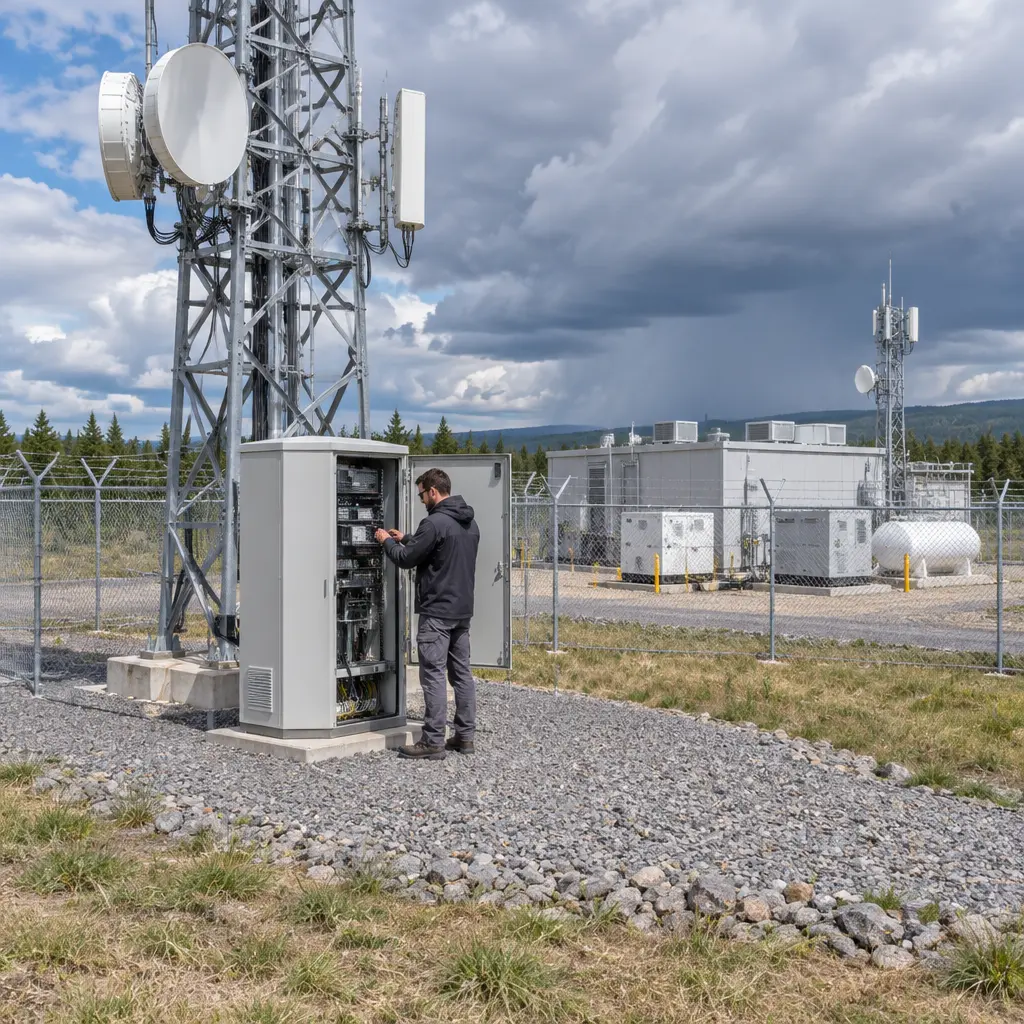
Heavy-storm signal attenuation is the weakening of radio, satellite, or optical signals as they pass through rain, snow, hail, or storm clouds. Preparing for it means identifying which links are vulnerable, adding alternate paths and reserve capacity, and monitoring conditions so operators can switch or recover service quickly. The risk is measurable: the U.S. National Oceanic and Atmospheric Administration reports that tropical cyclones, floods, and other weather hazards can damage communications infrastructure, while the International Telecommunication Union (ITU) provides engineering methods for estimating rain-related radio losses. The practical response depends on frequency, path length, storm intensity, and network design; this guide explains those factors, mitigation options, operational planning, and lessons from real disruptions.
Signal Attenuation and Weather Resilience
Signal attenuation is a reduction in signal power between a transmitter and receiver. In weather resilience planning, the relevant entity-attribute pairing is signal attenuation—weather susceptibility: the extent to which atmospheric conditions weaken a particular communications path. The ITU-R defines methods for predicting specific attenuation due to rain, including Recommendation P.838, which models how attenuation varies with rainfall rate, frequency, and polarization.
There is no single storm-loss figure that applies to every network. Rain loss depends strongly on operating frequency and the length of the path through precipitation. Higher-frequency links are generally more vulnerable: satellite links in Ku- and Ka-bands can experience noticeable rain fade, while many lower-frequency systems are less affected by rain but may face different interference, congestion, or infrastructure risks. A link budget and local weather data are therefore more useful than a broad assumption that all storm-related outages have the same cause.
Rain Fade: Precipitation Along the Radio Path
Rain fade is attenuation caused by absorption and scattering of radio energy by raindrops. ITU-R Recommendation P.838 provides a model for specific attenuation in decibels per kilometre, based on rainfall rate and signal frequency. Total loss depends on how much of the radio path intersects heavy rain, so a short terrestrial hop and a long satellite path can respond very differently to the same storm.
The relevant hyponyms include satellite rain fade, terrestrial microwave rain fade, and rain-related attenuation on point-to-point backhaul. Operators should assess each link using its frequency, elevation or path geometry, polarization, and local rainfall statistics. A rain gauge or weather-radar feed can help estimate risk, but real-time received-signal measurements are essential because storm cells can be highly localized.
Cloud, Snow, Hail, and Wet-Antenna Effects
Atmospheric and surface effects beyond rain can also weaken a link. Cloud and fog attenuation is most relevant at sufficiently high frequencies; wet snow, snow accumulation, and ice can obstruct antennas or alter their electrical characteristics. Water films on radomes and antenna covers may add loss, while wind-driven movement can misalign a dish even when atmospheric absorption is modest.
These conditions should be treated as related but distinct failure mechanisms. A link that remains within its rain-fade margin may still fail because an antenna has shifted, a feed is wet, or power has been lost at a remote site. Maintenance inspections, radome and drainage checks, secure mounting, and environmental monitoring help distinguish propagation loss from equipment or structural problems.
Storm Damage and Power-Related Outages
Weather disruption is broader than signal attenuation. Lightning, flooding, falling trees, high winds, and utility failures can damage towers, fiber routes, power systems, and electronics. NOAA’s National Centers for Environmental Information tracks major U.S. weather and climate disasters, illustrating the significant economic consequences of hazards that can also impair communications. Such physical outages cannot be solved by increasing transmit power alone; they require resilient sites, protected power, and diverse routes.
This distinction matters operationally: atmospheric fade is often temporary and recoverable through link adaptation, while a severed fiber cable or flooded equipment shelter may require field repair. Incident teams should classify alarms by likely cause and avoid treating every storm outage as a propagation issue.
Weather Attenuation Readiness and Link Budgets
A link budget is an accounting of transmitted power, antenna gains, propagation losses, and receiver sensitivity. For storm preparedness, the key attribute is link margin: the additional loss a link can tolerate before performance falls below its required threshold. ITU-R rain models and local precipitation records can inform the planned fade margin, but the design should also include uncertainty in equipment performance, alignment, and weather measurements.
Map Critical Links and Service Priorities
Begin by inventorying links that support emergency services, public safety, healthcare, control systems, and essential business operations. Record each link’s frequency, route, capacity, redundancy, power source, and acceptable outage duration. Map shared dependencies as well: two nominally separate paths may use the same tower, conduit, power feed, or storm-exposed region.
Assign service priorities before a storm occurs. For example, reserve bandwidth for voice dispatch, alarms, and operational telemetry, while allowing less critical traffic to be throttled. The U.S. Federal Communications Commission’s Disaster Information Reporting System (DIRS) and public outage reporting practices show why structured status collection is valuable during large incidents, although local operators still need their own asset-level visibility and escalation procedures.
Calculate Fade Margin and Availability Targets
Fade margin is the difference between the normal received signal level and the minimum level needed to meet a service objective. Engineers can estimate the expected rain loss using ITU-R P.838 together with rain-rate and path-length methods in ITU-R P.837 and P.530, where applicable. The design target should reflect the service’s required availability, local climate, frequency, and the cost of an outage.
Availability is commonly expressed as the percentage of time a service meets its performance criteria, but the percentage alone can hide the duration and timing of failures. A highly available link may still suffer a disruptive outage during a critical event. Evaluate both annual availability and worst-case storm performance, and validate modeled margins against measured signal levels from past storms or controlled tests.
Monitor Weather and Link Performance Together
Effective monitoring combines weather forecasts and radar with network telemetry such as received signal level, error rate, modulation changes, packet loss, and equipment alarms. The National Weather Service’s alerts and radar products can provide advance warning, while local sensors and network management systems reveal what is happening at a specific site.
A useful storm dashboard displays the forecast hazard, affected links, remaining fade margin, backup-path status, and estimated service impact. This joint view helps teams distinguish a forecasted risk from a confirmed degradation and initiate action before service crosses its failure threshold.
Mitigation Measures for Heavy-Storm Signal Attenuation
Mitigation combines radio engineering with network and site resilience. No single technique eliminates all weather outages: increased fade margin may address rain loss, but not a flooded equipment room or a regional power failure. The strongest plans layer measures so that a degraded link can adapt, traffic can move elsewhere, and essential equipment can continue operating.
Increase Link Margin and Adapt Transmission
Engineers can improve weather tolerance through suitable antenna sizing, transmit-power planning within regulatory limits, careful alignment, and receiver systems with adequate sensitivity. Adaptive coding and modulation can lower the data rate while preserving a connection as signal quality declines. Automatic transmit-power control may also compensate for fading where equipment, licensing, and interference constraints permit.
These methods trade capacity, power, and equipment cost against availability. A larger fade margin can increase resilience but does not guarantee service through every storm. Test adaptation thresholds and recovery behavior so that a link does not oscillate between modes or remain at reduced capacity after conditions improve.
Use Route, Band, and Technology Diversity
Diversity means providing alternative communications paths that are not exposed to the same failure. Options include geographically separated fiber routes, microwave links on different paths, lower-frequency backup links, cellular service from another carrier, or satellite backup using a different band or gateway. The alternative must be independent enough to remain available during the hazard affecting the primary path.
A backup that shares the same tower, power supply, or floodplain may fail alongside the primary. Conduct a dependency review and test failover under realistic traffic. Where full capacity is unaffordable, size the alternate path for prioritized services and define which applications will be limited during emergency operation.
Protect Sites, Power, and Field Operations
Physical protection addresses storm damage that radio adjustments cannot fix. Secure antennas and cables against wind, maintain lightning protection and grounding, elevate or seal equipment vulnerable to flooding, and verify that shelters have suitable drainage and ventilation. Backup batteries and generators should be tested under load, with fuel, transfer switches, and replenishment plans included in readiness checks.
Field work itself can become hazardous during severe weather. Establish stop-work criteria for lightning, high winds, flooding, and poor visibility; pre-stage replacement parts where safe; and coordinate site access with emergency authorities. A repair plan that depends on technicians reaching an exposed tower during the height of a storm is not a reliable resilience measure.
Operational Response and Recovery During Storms
Operational readiness turns engineering controls into a coordinated response. The National Institute of Standards and Technology’s contingency-planning guidance emphasizes preparation, response, recovery, and testing for information systems. For communications teams, this means assigning decision authority, documenting thresholds, and rehearsing transitions before severe weather arrives.
Trigger Actions Before Degradation Becomes an Outage
Set triggers using both forecast severity and live link measurements. For example, a falling signal level, rising error rate, or forecast arrival of intense precipitation can prompt capacity reservation, traffic prioritization, or a controlled switch to a backup path. Exact thresholds must be established from the equipment and service objectives rather than copied from another network.
Use a concise runbook that identifies who can authorize a switch, how users are notified, which services receive priority, and how to roll back. Automation can reduce response time, but it should be monitored and tested to prevent unnecessary route changes or loops during rapidly fluctuating conditions.
Communicate Status and Coordinate Dependencies
Storm response often involves network operators, utilities, emergency management, vendors, and customers. Share consistent status information: the affected service, geographic area, likely cause, current workaround, and next update time. Confirm vendor escalation paths and spare-equipment availability in advance, especially for remote sites where access may be delayed.
For critical services, maintain an out-of-band communication method that does not depend on the infrastructure under stress. This can include independent cellular service, satellite messaging, radio, or prearranged contact procedures. The choice should match the threat model and be exercised with the people expected to use it.
Recover, Inspect, and Learn After the Event
After a storm, confirm that primary links are stable before restoring normal traffic. Inspect antennas, mounts, grounding, cables, shelters, backup power, and drainage. Preserve telemetry and incident records so teams can compare forecast conditions with actual signal loss, equipment alarms, and outage duration.
A post-event review should identify whether the failure was caused by atmospheric attenuation, physical damage, power loss, congestion, or a combination. Update fade margins, maintenance schedules, route-diversity assumptions, and response thresholds based on evidence rather than treating each event as an isolated anomaly.
Case Lessons and Practical Readiness Checklist
Major storms demonstrate that communications resilience depends on both network design and restoration logistics. During Hurricane Katrina in 2005, widespread damage to power and telecommunications infrastructure disrupted services across the Gulf Coast; the Federal Communications Commission’s subsequent investigations documented extensive outages and the need for improved emergency communications coordination. The event was not simply a signal-attenuation problem: physical destruction, power loss, and access constraints were central factors.
More recent disaster reporting by NOAA likewise shows that high-impact weather can affect multiple infrastructure systems at once. For operators, the lesson is to plan for compound failures: a rain-faded satellite link may coincide with a power outage, while flooded roads delay repair crews. A diagram could usefully show a primary link, an independent backup route, reserve power, and the storm-related failure points each is designed to address.
- Inventory critical links, frequencies, route dependencies, and service priorities.
- Estimate rain loss using recognized ITU-R methods and validate the resulting fade margin against local measurements.
- Combine weather alerts with live signal, error-rate, power, and equipment monitoring.
- Provide tested, physically diverse backup paths and define emergency traffic priorities.
- Inspect antenna alignment, mounting, grounding, drainage, shelter protection, batteries, and generators before storm season.
- Exercise failover and communications procedures, then revise plans using post-storm evidence.
Conclusion: Build Resilience Before the Storm
Weather-related signal attenuation is governed by the link’s frequency, path, precipitation exposure, and available fade margin, while storm outages can also arise from damage to power and communications infrastructure. Reliable preparation therefore combines ITU-informed link engineering, continuous weather and network monitoring, route diversity, protected sites, backup power, and practiced response procedures.
Organizations should begin with a critical-link inventory, test realistic failover, and review local hazard and outage records before the next storm season. Consult current ITU-R propagation recommendations, National Weather Service alerts, and applicable emergency communications guidance when refining plans. Proactive testing is more dependable—and safer—than relying on emergency repairs after a storm has already disrupted service.
Sources: International Telecommunication Union, Recommendation ITU-R P.838-3: Specific Attenuation Model for Rain for Use in Prediction Methods, https://www.itu.int/rec/R-REC-P.838/en; International Telecommunication Union, Recommendation ITU-R P.837-7: Characteristics of Precipitation for Propagation Modelling, https://www.itu.int/rec/R-REC-P.837/en; International Telecommunication Union, Recommendation ITU-R P.530-18: Propagation Data and Prediction Methods Required for the Design of Terrestrial Line-of-Sight Systems, https://www.itu.int/rec/R-REC-P.530/en; National Oceanic and Atmospheric Administration, National Centers for Environmental Information, U.S. Billion-Dollar Weather and Climate Disasters, https://www.ncei.noaa.gov/access/billions/; Federal Communications Commission, Disaster Information Reporting System, https://www.fcc.gov/general/disaster-information-reporting-system-dirs; National Institute of Standards and Technology, Contingency Planning Guide for Federal Information Systems, Special Publication 800-34 Revision 1, https://csrc.nist.gov/pubs/sp/800/34/r1/upd1/final; Federal Communications Commission, Hurricane Katrina: Communications Damage and Recommendations, https://www.fcc.gov/reports-research/reports/hurricane-katrina-communications-damage-and-recommendations; National Weather Service, Weather Forecast Office and Radar Services, https://www.weather.gov/.