
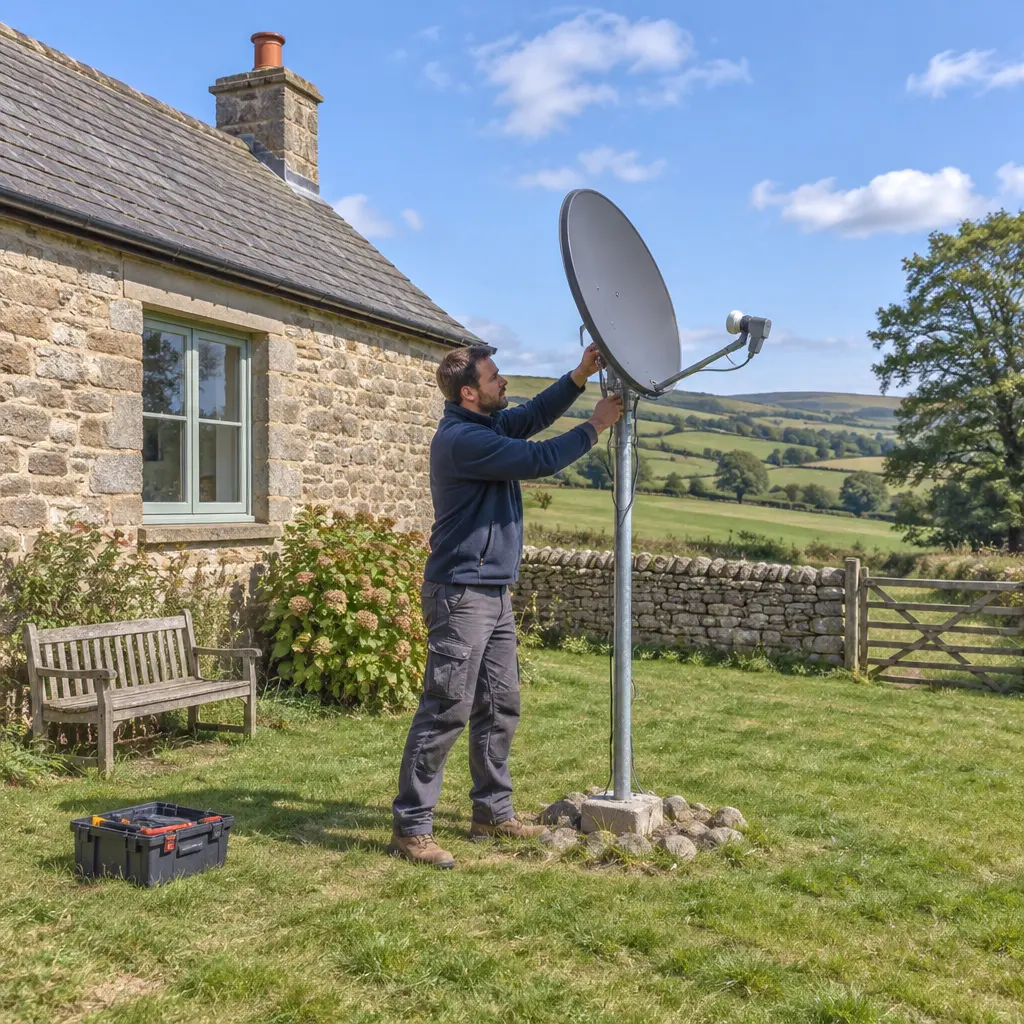
Satellite internet is broadband delivered between a user’s dish or terminal and an orbiting satellite, then routed through a ground gateway to the wider internet. It reaches places where laying fiber or cable is difficult, slow, or uneconomic: remote communities, ships, aircraft, disaster zones, and rural homes. The connection works through a chain of user terminals, satellites, gateways, and network control systems. Its performance depends in part on orbit: low Earth orbit (LEO) can reduce signal delay, while geostationary orbit (GEO) covers broad areas with fewer satellites but typically has higher latency. Satellite service can close coverage gaps, but it does not automatically guarantee affordability, capacity, or reliable performance.
How Satellite Internet Delivers Connectivity Beyond Cable Networks
Satellite internet is a communications service that sends data between an internet-connected device and a satellite using radio signals. The U.S. Federal Communications Commission (FCC) describes satellite broadband as a way to provide internet access in areas that terrestrial networks may not reach. Unlike a cable connection, it does not require a continuous physical line from a local provider to the customer. That makes it especially useful where terrain, distance, low population density, or damaged infrastructure makes ground-based networks difficult to build.
The need is substantial, though the exact size of the connectivity gap depends on the measure used. In its 2024 report, the International Telecommunication Union (ITU) estimated that about 2.6 billion people remained offline worldwide in 2023. Satellite networks are one part of the response, alongside fiber, mobile networks, and community connectivity projects. The key trade-off is that satellite can extend reach without local cable, but available capacity, weather, equipment costs, and latency still shape the experience.
Satellite Internet Coverage and Network Architecture
Satellite internet coverage is the geographic area in which a satellite system can provide a usable communications link. Coverage is not the same as service availability: a satellite may illuminate a region, while the operator still has to manage capacity, licensing, ground infrastructure, and customer equipment there. The system generally links a user terminal to a satellite, then to a gateway connected to terrestrial internet networks. Some newer systems also use inter-satellite links to pass data between spacecraft before reaching a gateway.
The main categories are geostationary, medium Earth orbit, and low Earth orbit systems. Their different heights affect how many satellites are needed, how much area each can cover, and how long signals take to travel. Those orbital choices determine much of the user experience, so understanding the route a signal takes helps explain why satellite services can differ so widely.
Geostationary satellites: broad reach and higher latency
A geostationary satellite orbits above the equator at about 35,786 kilometers and moves at the same angular speed as Earth’s rotation, appearing nearly stationary over one point. This enables a fixed dish to remain pointed at the same satellite, and a small number of spacecraft can cover very large regions. The physical distance, however, creates noticeable delay: a signal traveling from a user to a satellite and back to a gateway must cover a long route. The FCC has noted that satellite latency can be higher than that of terrestrial broadband, which can affect real-time applications such as video calls and some online games.
Low Earth orbit: shorter routes and moving satellites
Low Earth orbit satellites operate much closer to Earth, commonly at altitudes below 2,000 kilometers. Because the radio path is shorter, LEO systems can provide lower latency than traditional GEO services. The trade-off is that each satellite covers a smaller area and moves rapidly across the sky, so providers use large constellations and coordinate handoffs as terminals switch between spacecraft. The European Space Agency explains that LEO satellites typically complete an orbit in roughly 90 to 120 minutes, depending on altitude. For customers, network design and congestion still matter: a low orbit alone does not guarantee a particular speed or response time.
Medium Earth orbit and hybrid networks
Medium Earth orbit (MEO) sits between LEO and GEO, offering a compromise in coverage area, satellite count, and signal delay. MEO is used in some broadband and specialized communications networks, though it is less familiar to many household customers. Hybrid systems combine satellite links with fiber, mobile, or other terrestrial networks. A satellite may connect a remote site to a nearby ground network, while local Wi-Fi or cellular service distributes the connection to users. This mix is useful because satellites solve the long-distance backhaul problem, while local networks handle the final connection to devices.
Satellite Internet Signal Path and User Equipment
A satellite internet signal path is the sequence of radio links and network handoffs that carries data between a customer and an online destination. In a typical arrangement, a device sends a request through a router and satellite terminal; the terminal transmits it to a satellite; the satellite relays it to a gateway; and the gateway connects to terrestrial internet infrastructure. The response returns by a compatible route. The exact path varies by provider and constellation, but the basic components explain why satellite service can work without a cable running to the home.
User terminals, antennas, and installation
A user terminal is the equipment that sends and receives signals between a customer’s network and the satellite system. Traditional services often use a dish aligned toward a GEO satellite; many LEO services use electronically steered flat-panel antennas that track satellites without a large mechanical dish. The terminal connects to a modem or router, which then provides internet access over Ethernet or Wi-Fi. A clear view of the relevant part of the sky is important, because buildings, trees, or terrain can obstruct the signal. Installation, power requirements, and equipment price can therefore affect whether service is practical at a particular site.
Gateways, ground stations, and inter-satellite links
A gateway is a ground facility that connects satellite traffic to terrestrial networks. Gateways typically include antennas, radio equipment, and links to internet providers or data centers. In some systems, satellites can relay traffic to one another using inter-satellite links, potentially allowing data to travel across a constellation before reaching a gateway. This can help serve locations far from a ground station, but the overall network still depends on routing, gateway availability, spectrum coordination, and sufficient capacity. A satellite overhead is therefore only one part of a functioning broadband service.
Latency, capacity, weather, and service quality
Latency is the time data takes to travel between a user and a destination; capacity is the amount of traffic a network can carry. Orbit strongly influences latency, while the number of users sharing a beam, available spectrum, network design, and gateway connections influence capacity. Rain can weaken some satellite radio signals, particularly at higher frequencies, a phenomenon known as rain fade. Providers can mitigate weather effects through link design and network management, but severe conditions or physical obstructions may still disrupt service. Users should compare published performance information with local availability and understand that speed tests can vary by time and location.
Where Satellite Internet Makes the Greatest Difference
Satellite internet is most valuable where the cost or difficulty of building a terrestrial network is high. It can provide a connection without waiting for a cable route to be constructed, making it useful for isolated settlements and mobile operations. The service is also valuable as a backup: when a storm, wildfire, earthquake, or other event damages local infrastructure, satellite links may provide an alternative communications route, provided terminals have power and a usable sky view.
Rural and remote households
In rural areas, homes may be separated by long distances, rugged terrain, or water, making fiber deployment expensive per customer. Satellite can connect households, farms, schools, clinics, and small businesses beyond the practical reach of existing cables. Its usefulness depends on more than coverage: households need affordable equipment and subscriptions, reliable electricity, and enough network capacity during busy periods. Public programs that support broadband adoption may help address affordability, while fiber and fixed wireless remain important alternatives where they can be built sustainably.
Ships, aircraft, and other mobile users
Ships and aircraft cannot rely on a fixed terrestrial cable while traveling, so they use satellite terminals to maintain communications across oceans and remote routes. Satellite connectivity can support navigation-related data, crew communications, passenger internet, and operational monitoring. Mobile service requires equipment designed to track satellites while the platform moves, as well as agreements and network coverage along the route. The same principle serves remote industrial sites, research stations, and temporary field operations.
Disaster response and resilient communications
Satellite links can support emergency communications when terrestrial infrastructure is unavailable or overloaded. After a disaster, response teams may deploy portable terminals to connect field offices, medical facilities, shelters, or logistics hubs. Satellite is not immune to disruption: terminals need power, clear placement, working equipment, and access to the provider’s network. A resilient plan therefore combines satellite with other communications methods, spare power, trained operators, and tested procedures rather than treating any single technology as a complete solution.
Benefits, Limits, and Real-World Trade-Offs
Satellite internet’s central benefit is geographic reach: it can connect a location without extending a physical cable to that site. Its limitations include equipment and service costs, latency differences between orbital systems, shared capacity, weather sensitivity, and dependence on a functioning satellite and gateway network. These factors matter for households choosing a provider and for governments deciding how to close connectivity gaps. Satellite is often strongest as part of a broader broadband mix, rather than as a universal replacement for fiber or mobile networks.
Coverage does not always mean affordability
A satellite footprint can include a remote community even when service remains difficult to afford or subscribe to. Customers may need to pay for a terminal, installation, monthly service, and replacement equipment. The ITU’s global connectivity reporting emphasizes that meaningful access involves more than being within network range; affordability, skills, and usable service also matter. For public broadband planning, satellite coverage maps should therefore be considered alongside prices, performance, local demand, and other available technologies.
Capacity constraints and the role of ground networks
Satellite capacity is shared among users within a service area, so performance may change as demand rises. A network can cover a wide region yet provide limited bandwidth per customer if resources are stretched. Gateways and terrestrial backhaul also matter: data must eventually connect to internet exchange points, data centers, or other networks. This is why satellite and terrestrial infrastructure are complements. Fiber can carry high volumes of traffic efficiently near population centers, while satellite can extend the connection across the last difficult distance.
A practical comparison of satellite orbits
The comparison below summarizes typical design trade-offs rather than guaranteed service levels. Actual performance varies by operator, frequency band, terminal, location, network load, and weather.
- GEO: very broad coverage per satellite and relatively simple fixed-dish tracking, but long signal paths and higher latency.
- MEO: intermediate coverage and latency, with fewer satellites generally needed than for LEO systems.
- LEO: shorter signal paths and potential for lower latency, but requires many satellites, frequent handoffs, and careful capacity management.
A useful graphic for readers would be a side-by-side orbit diagram showing Earth, GEO, MEO, and LEO altitude bands, paired with arrows tracing a customer request through a satellite and gateway. Such a visual should distinguish orbital height from advertised service speed, since they are related but not interchangeable measures.
Conclusion: Satellite Internet Extends the Reach of Broadband
Satellite internet reaches places cables cannot by routing data between user terminals, satellites, and gateways rather than relying on a continuous local cable. GEO systems offer broad coverage but generally longer signal delays; LEO systems bring satellites closer to Earth and can reduce latency, while requiring large constellations and frequent handoffs. MEO and hybrid networks provide additional approaches. Across rural communities, mobile platforms, and disaster response, satellite connectivity can fill important gaps, but coverage must be evaluated alongside cost, capacity, weather resilience, and terrestrial backhaul.
For households and organizations, compare local availability, total equipment and subscription costs, expected performance, data policies, and installation requirements. For communities and policymakers, use satellite as one tool within a technology-neutral connectivity plan that also considers fiber, fixed wireless, and mobile networks. Understanding how the orbit and signal path shape service is the first step toward choosing the right connection for places beyond the cable network.
Sources: International Telecommunication Union, Facts and Figures 2023, https://www.itu.int/itu-d/reports/statistics/facts-figures-2023/; Federal Communications Commission, Satellite Broadband, https://www.fcc.gov/general/satellite-broadband; European Space Agency, Types of Orbits, https://www.esa.int/Enabling_Support/Space_Transportation/Types_of_orbits; Federal Communications Commission, 2024 Communications Marketplace Report, https://www.fcc.gov/reports-research/reports/communications-marketplace-reports/2024-communications-marketplace-report