
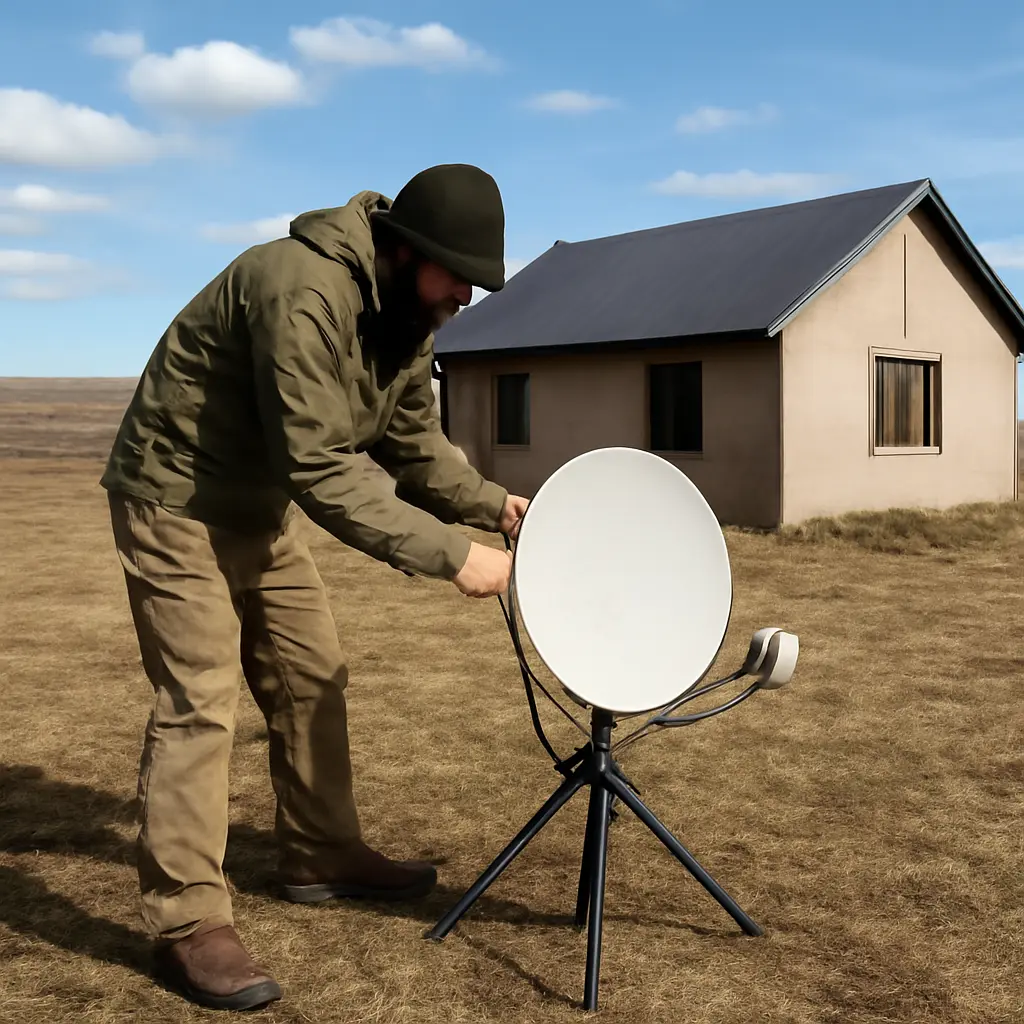
Satellite internet is broadband access delivered through communications satellites between a user’s dish or terminal and a network gateway. It can connect homes, businesses, ships, aircraft, and emergency teams beyond the reach of cable and fiber, though performance depends on satellite orbit, network capacity, weather, equipment, and plan terms. The Federal Communications Commission (FCC) defines broadband using performance benchmarks that it updates over time; in its 2024 report, it raised the benchmark to 100 Mbps download and 20 Mbps upload. Satellite services vary widely against that measure: low-Earth-orbit networks can offer lower latency than traditional geostationary services, while both can extend connectivity to remote locations. This guide explains how satellite internet works, compares its main types, reviews speed, latency, costs, and limitations, and offers practical advice on choosing and using a service.
How Satellite Internet Works: Network Architecture and Signal Path
Satellite internet is a two-way data service in which a user terminal sends and receives signals through a satellite network. The International Telecommunication Union (ITU) describes satellite communications as using space stations to relay radio signals between locations on Earth. In a typical home setup, data travels from a dish or flat-panel terminal to a satellite, then to a ground gateway connected to the wider internet; downloads follow the reverse route. Some systems use inter-satellite links to pass traffic between spacecraft before it reaches a gateway.
User terminal, satellite, and gateway
The user terminal includes an antenna, radio-frequency electronics, and a modem or router. A gateway is a ground station that links the satellite network to terrestrial internet infrastructure. Signal quality depends on factors such as antenna alignment, clear view of the sky, frequency band, atmospheric conditions, and congestion. Unlike a cellular hotspot, satellite service does not require a nearby mobile tower, but it does require compatible equipment and a usable satellite view.
Orbit determines coverage and responsiveness
Satellites are commonly grouped by orbit. Geostationary Earth orbit (GEO) satellites circle at about 35,786 kilometers above the equator and appear nearly stationary from the ground, allowing a fixed dish to point at one location in the sky. Medium-Earth orbit (MEO) satellites fly lower than GEO spacecraft but higher than LEO systems. Low-Earth orbit (LEO) satellites operate at altitudes generally below 2,000 kilometers and move rapidly relative to the user, so networks rely on multiple satellites, tracking antennas, and handoffs.
Satellite Internet Types: GEO, MEO, and LEO Services
Orbit type is the most important distinction among satellite internet services because it shapes latency, coverage design, equipment, and network capacity. The FCC’s 2024 Communications Marketplace Report documents the continuing role of satellite providers in connecting locations where terrestrial broadband options are limited. No orbit is universally best: the right option depends on location, application, budget, and available providers.
Geostationary satellite internet
GEO service uses satellites that remain above roughly the same point on Earth. Their high altitude lets one spacecraft cover a very large region, making GEO a practical option for broad-area and remote coverage. The trade-off is distance: a signal must travel thousands of kilometers each way, which creates higher latency than lower-orbit systems. GEO can support browsing, email, video streaming, and many business applications, but real-time gaming, remote-control tasks, and interactive video calls may feel less responsive. Providers may also impose data thresholds or traffic-management rules, so advertised speed alone does not describe the full service.
Low-Earth-orbit satellite internet
LEO services use constellations of satellites moving across the sky, with network software handing a connection from one spacecraft to another. Because the satellites are much closer to Earth than GEO spacecraft, signal travel time can be substantially lower. The European Space Agency notes that LEO satellites typically orbit at altitudes below 2,000 kilometers. LEO systems can be suitable for video calls, cloud applications, and many online games, but performance still varies with congestion, gateway availability, obstructions, and local weather. Their coverage and capacity also depend on constellation deployment and regulatory authorization.
Medium-Earth-orbit and specialized systems
MEO networks sit between LEO and GEO in altitude and can serve specialized broadband, mobility, or enterprise needs. Other satellite systems focus on narrowband data, Internet of Things (IoT) connections, maritime service, aviation, or emergency communications rather than household broadband. These categories matter because a satellite phone, a vessel’s broadband terminal, and a residential internet dish may use satellite infrastructure but have very different throughput, pricing, and service expectations.
Satellite Internet Performance: Speed, Latency, and Reliability
Satellite internet performance is not a single number. Download speed describes how quickly data arrives; upload speed measures how quickly it is sent; latency is the delay before a response begins; and reliability reflects how consistently the connection remains available. The FCC’s 100/20 Mbps fixed-broadband benchmark is a useful point of comparison, but actual satellite plans and measured results vary. Users should check the provider’s service disclosures, not assume that advertised maximums represent a guaranteed everyday experience.
Speed and capacity
Available speed depends on the service plan, network load, signal conditions, equipment, and the number of users sharing capacity. A connection that handles one high-definition stream may struggle when several people stream, download large files, and join video meetings at once. The FCC’s broadband labels are intended to help consumers compare key plan details, including typical speeds, pricing, and data allowances where applicable. For a household, consider both download and upload needs: remote work, cloud backups, and video calls can make upstream capacity especially important.
Latency and real-time applications
Latency is commonly measured in milliseconds and reflects the time for data to travel between a device and a remote server. GEO’s long signal path generally produces much higher latency than LEO, even when download speeds appear similar. Lower latency improves the feel of interactive tasks such as voice calls, online gaming, and remote desktop sessions. However, the experience also depends on routing, server distance, Wi-Fi quality, and network congestion. A speed test should therefore include latency and, where possible, measurements at different times of day.
Weather, obstructions, and uptime
Rain, snow, and dense cloud can weaken some satellite signals, particularly at higher frequencies; this effect is often called rain fade. Trees, buildings, terrain, and roof features can obstruct a LEO terminal’s changing view of the sky or block a fixed GEO dish’s line of sight. Installers and provider apps may help identify a suitable location, but a clear view remains important. Battery backup, a secondary cellular connection, or a second internet provider can improve resilience for businesses and households that cannot tolerate an outage.
Satellite Internet Costs, Equipment, and Data Policies
The total cost of satellite internet includes more than the monthly subscription. A buyer may pay for a terminal, mounting hardware, shipping, installation, taxes, and optional service features. Terms differ by provider and country, so compare the complete cost over the expected period of use. Check whether equipment is purchased, rented, or financed and whether there are return fees or service commitments.
Equipment and installation
A GEO system often uses a dish carefully aimed at a satellite, while many LEO systems use electronically steered flat-panel terminals that track satellites without a conventional moving dish. The terminal connects to a router or integrated Wi-Fi unit. A do-it-yourself installation may lower upfront costs, but a professional installer can help with roof mounting, cable routing, grounding, and safe placement. Check local building rules and avoid installations that compromise roof integrity or create hazards.
Data allowances and network management
A plan’s “unlimited” label does not always mean unlimited priority access or identical speeds at all times. Some providers apply data thresholds, deprioritize heavy use during congestion, or offer separate priority-data tiers. Streaming, operating-system updates, video calls, and cloud backups can use substantial data. Before subscribing, read the plan’s data policy and determine how the provider handles congestion, hotspot use, travel, and service pauses.
Satellite Internet Uses: Rural Homes, Mobility, and Emergency Response
Satellite internet is most valuable where fiber, cable, or dependable fixed wireless is unavailable, but its use extends well beyond rural households. Because satellites cover wide areas, they can connect mobile platforms and support communications when terrestrial networks are damaged. The World Bank and ITU have both highlighted connectivity gaps as a barrier to education, commerce, public services, and social participation; satellite can help address some of those gaps when paired with affordable devices and suitable service.
Rural and remote communities
For farms, remote homes, field stations, and isolated communities, satellite can provide a connection without waiting for a cable or fiber buildout. It may support online learning, telehealth, business operations, and access to government services. A real-world example is the use of satellite links at remote research sites, where a gateway connection can carry data from locations far from wired networks. The service is not a substitute for every local infrastructure investment: affordability, digital skills, and dependable power remain essential to meaningful access.
Maritime, aviation, and transport
Ships, aircraft, and some land vehicles use satellite terminals to stay connected outside the reach of ordinary terrestrial networks. Maritime connectivity supports navigation data, crew communications, and passenger access; aviation systems can provide operational links and onboard internet. Mobile services often cost more than residential plans because equipment must operate in demanding environments and maintain a connection while moving. Buyers should verify geographic coverage, roaming rules, antenna requirements, and whether service is permitted in each jurisdiction.
Disaster response and network resilience
After a wildfire, hurricane, earthquake, or other emergency damages local infrastructure, satellite terminals can restore communications for responders, shelters, and affected communities. Satellite service is not immune to power loss, equipment damage, congestion, or severe weather, so it works best as part of a broader resilience plan. Emergency organizations should test equipment in advance, keep power sources available, train staff, and coordinate frequency and service requirements with relevant authorities.
Choosing Satellite Internet: A Practical Comparison Checklist
Choosing a provider starts with confirming what services are actually available at the installation address. Compare satellite plans with fiber, cable, fixed wireless, and cellular home internet where those options exist. The best service is the one that meets the user’s needs at a sustainable total cost, not necessarily the one with the highest advertised speed.
- Confirm coverage, service availability, and any waitlist or capacity limits at your exact location.
- Compare typical download and upload speeds, latency, data policies, and service guarantees.
- Calculate total first-year and ongoing costs, including equipment, installation, fees, and taxes.
- Check terminal placement requirements, sky visibility, weather exposure, and power needs.
- Review contract terms, equipment ownership, return conditions, travel rules, and support options.
- Match the plan to actual usage, including simultaneous video streams, work calls, gaming, and backups.
- Read the provider’s broadband label and service terms, and ask how congestion affects performance.
A simple comparison chart can make trade-offs visible: list each provider in rows and speed, latency, data policy, equipment cost, monthly price, and availability in columns. Test performance after installation at several times of day and, if service falls short, document results before contacting support.
Conclusion: Satellite Internet’s Role in Global Connectivity
Satellite internet connects users through spacecraft, ground gateways, and customer terminals, with GEO, MEO, and LEO systems offering different balances of coverage and responsiveness. Orbit influences latency; speed and reliability also depend on capacity, weather, obstructions, and plan rules. The technology enables broadband in remote areas, supports mobile industries, and can restore communications during disasters, while cost, data management, and line-of-sight requirements remain important considerations.
Before choosing a service, compare available terrestrial alternatives, read the provider’s disclosures, and assess the full cost and performance needed for your household or organization. As satellite constellations and ground infrastructure evolve, continued attention to affordability, competition, orbital safety, and equitable access will shape how much benefit these networks deliver. For further research, consult the FCC’s broadband reports and consumer labels, ITU material on satellite communications, and the European Space Agency’s explanations of satellite orbits.
Sources: Federal Communications Commission, 2024 Communications Marketplace Report, https://www.fcc.gov/reports-research/reports/communications-marketplace-reports; Federal Communications Commission, 2024 Section 706 Report, https://www.fcc.gov/document/fcc-issues-2024-section-706-report; Federal Communications Commission, Broadband Labels, https://www.fcc.gov/broadbandlabels; International Telecommunication Union, Satellite communications, https://www.itu.int/en/mediacentre/backgrounders/Pages/Satellite-communications.aspx; European Space Agency, Types of Orbits, https://www.esa.int/Enabling_Support/Space_Transportation/Types_of_orbits; World Bank, Digital Development Overview, https://www.worldbank.org/en/topic/digitaldevelopment/overview.