
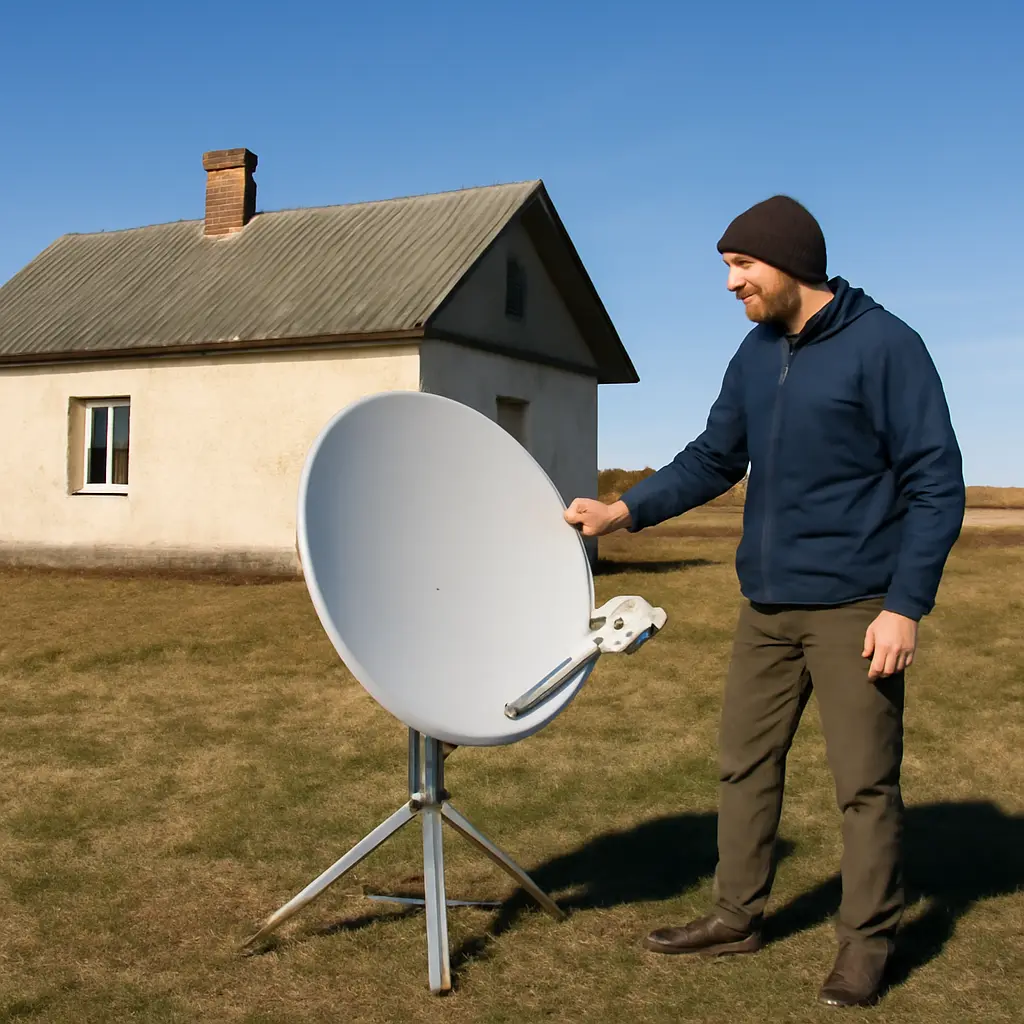
Satellite internet is broadband delivered from satellites in orbit to a dish or other terminal at a customer’s location. Its central advantage is reach: it can connect homes, vessels, and remote communities where wired networks are unavailable, while its main trade-offs are price, data limits, weather sensitivity, and latency that varies by satellite orbit. The Federal Communications Commission (FCC) reported that roughly 24 million people in the United States lacked access to fixed broadband meeting its benchmark in 2022, illustrating why satellite service remains important even as newer networks improve performance. Understanding satellite internet means comparing its orbit types, benefits, limitations, and real-world uses—not assuming every service performs the same.
Satellite internet performance depends on orbit and network design
Satellite internet is a communications service that sends data between a user terminal, one or more satellites, and a ground network connected to the wider internet. The FCC defines satellite broadband as service delivered through communications satellites, distinguishing it from terrestrial connections such as cable, fiber, and fixed wireless. Performance depends on the satellite’s altitude, available spectrum, network capacity, gateway locations, and the user’s equipment.
The principal categories are geostationary (GEO), medium Earth orbit (MEO), and low Earth orbit (LEO). They differ in distance and coverage: GEO satellites cover large regions from far above Earth, whereas LEO systems orbit closer and rely on many satellites moving across the sky. These design differences explain why satellite internet can be broadly accessible but vary substantially in speed, latency, and consistency.
Geostationary satellites: broad coverage, higher latency
A geostationary satellite circles Earth above the equator at about 35,786 kilometers, matching Earth’s rotation so it appears fixed over one location. A single GEO satellite can cover a very large area, making this approach useful for rural broadband, broadcasting, and backup connectivity. The long signal path, however, creates a noticeable delay: even a signal traveling at the speed of light takes roughly a quarter of a second to make a one-way journey to the satellite, before network processing and the return path are counted.
That delay can make interactive activities—such as fast-paced online games, remote desktop work, and some video calls—feel less responsive. GEO services can still support browsing, email, streaming, and many routine business tasks, but users should check provider-specific latency and data policies rather than relying only on advertised download speeds.
Low Earth orbit satellites: lower latency, moving coverage
LEO satellites operate much closer to Earth, commonly at altitudes of a few hundred to around 2,000 kilometers. Because the signal travels a shorter distance, LEO systems can offer substantially lower latency than traditional GEO services. SpaceX’s Starlink, for example, reported median latency of about 33 milliseconds for U.S. fixed users in the FCC’s 2023 Measuring Broadband America program; actual results vary by location, plan, network load, and measurement period.
LEO satellites move quickly relative to users, so providers coordinate handoffs among satellites and maintain large constellations to provide continuous coverage. This can improve responsiveness, but service still depends on an unobstructed view of the sky, adequate local capacity, and a functioning ground network. LEO also raises broader concerns about orbital congestion, collision avoidance, and the long-term management of space debris.
Medium Earth orbit and hybrid satellite networks
MEO satellites orbit between LEO and GEO, offering a middle ground in altitude, coverage footprint, and latency. MEO systems are used in some enterprise, aviation, and government networks, though they are less familiar to residential consumers. Hybrid networks combine satellite links with fiber, cellular, or other terrestrial connections, selecting routes according to availability and traffic needs. This approach can improve resilience, but the overall experience depends on the quality of every component in the connection.
Satellite internet expands access where terrestrial broadband is limited
The strongest case for satellite internet is geographic reach. Unlike fiber or cable, satellite service does not require a continuous physical cable route to every home. A terminal can connect in rural areas, on ships, aircraft, and at temporary work sites, provided the location is within the provider’s coverage area and has a suitable view of the sky. This makes satellite a complement to terrestrial networks, especially where building infrastructure is costly or slow.
Rural and remote household connectivity
For households beyond cable and fiber footprints, satellite can provide a practical way to access online education, telehealth, government services, and employment. The FCC’s 2024 Broadband Progress Report estimated that about 24 million Americans lacked access to fixed broadband at the agency’s benchmark of 25 megabits per second download and 3 megabits per second upload, with rural and Tribal areas disproportionately affected. Satellite can help address these gaps, although affordability, installation, and local capacity still determine whether access is meaningful.
A useful comparison is availability versus performance: a service may reach an isolated address but still face congestion during busy periods or impose data restrictions. Prospective customers should compare the actual plan terms, equipment costs, expected speeds, and alternatives such as fixed wireless or community broadband.
Mobility, emergency response, and business continuity
Satellite links are valuable when users are moving or when terrestrial infrastructure is disrupted. Maritime operators use them for navigation support, operational communications, and crew connectivity; airlines use satellite systems for onboard connectivity; and emergency teams may deploy portable terminals when storms, fires, or earthquakes damage local networks. These uses depend on specialized plans and equipment, and consumer residential service is not automatically suitable for vehicles or use in motion.
Satellite can also act as a backup connection for businesses with critical communications needs. A diverse backup path reduces reliance on a single cable route, though it cannot eliminate outages caused by power loss, terminal failure, severe weather, or problems at a provider’s gateways and data centers.
Satellite internet’s disadvantages affect cost, reliability, and responsiveness
Satellite connectivity is not a universal replacement for fiber or cable. Its limitations follow from both the physics of radio communication and the economics of deploying and maintaining space infrastructure. The most relevant drawbacks are total cost, latency, capacity constraints, environmental conditions, and equipment requirements.
Higher total costs and plan restrictions
A satellite plan’s cost may include a monthly service fee, a terminal or installation charge, shipping, and optional priority data. Prices and policies vary by country and provider, so a low advertised monthly price may not reflect the full cost of getting online. Some plans also manage traffic after a specified data threshold or prioritize certain customers during congestion. Users should read current plan terms carefully, particularly if a household streams heavily, downloads large files, or operates a business.
For comparison, the FCC’s broadband labels require providers to disclose information such as monthly price, introductory pricing, data allowances, and typical speeds for covered plans. Reviewing those disclosures alongside satellite-specific equipment and installation charges can make comparisons more reliable.
Latency and performance variability
Latency is the time data takes to travel between a user and an internet destination. GEO services generally have higher latency because of orbital distance, while LEO services can reduce it but may still experience variation from congestion, routing, handoffs, and ground-network conditions. Download speed alone therefore does not describe the full experience: video calls and interactive applications also depend on latency, upload speed, packet loss, and consistency.
Advertised speeds are not guarantees of continuous performance. The FCC’s Measuring Broadband America reports assess providers using repeated measurements and show why consumers should consider typical performance and service conditions, not just a maximum rate stated in marketing materials.
Weather, obstructions, and installation requirements
Satellite signals can be weakened by heavy rain, wet snow, and other atmospheric conditions, an effect often called rain fade. Buildings, trees, and terrain can block the path between a terminal and the satellite; LEO terminals may need a wider, unobstructed sky view because satellites move across the horizon. Correct placement and a secure installation are important, and some homes may need roof or pole mounting to avoid obstructions.
A short interruption during severe weather is different from a persistent coverage problem. Before purchase, users can check the provider’s obstruction guidance, confirm whether installation is included, and ask what support or equipment replacement is available if the connection becomes unreliable.
Choosing satellite internet requires matching service to the use case
The right choice depends on what alternatives are available and how the connection will be used. Satellite is most compelling when geographic access or mobility matters more than the lowest possible price or the minimum latency. Where fiber or cable is available and affordable, those services often provide higher capacity and more predictable performance; fixed wireless or cellular broadband may also be viable alternatives.
A practical comparison checklist
- Check whether fiber, cable, fixed wireless, or 5G home internet is available at the exact address.
- Compare typical download and upload speeds, latency, data policies, and congestion terms—not just headline maximum speeds.
- Calculate total first-year cost, including equipment, installation, shipping, taxes, and any service commitments.
- Confirm coverage, expected sky visibility, weather limitations, and whether the plan supports the intended fixed or mobile use.
- Consider the consequences of an outage and whether a cellular hotspot or second connection is needed for backup.
What satellite internet can—and cannot—solve
Satellite can extend broadband availability to locations that are expensive to serve with terrestrial infrastructure and can provide a communications path during emergencies. It cannot by itself guarantee affordable service, equal performance everywhere, or a substitute for resilient local networks. Public policy and network planning therefore benefit from treating satellite as one part of a broader connectivity system that includes fiber backbones, wireless access, community networks, and reliable power.
Conclusion: Satellite internet trades terrestrial reach for cost and performance considerations
Satellite internet’s defining advantage is access: GEO, MEO, and LEO systems can connect places and users that conventional wired networks may not reach. LEO networks have narrowed the latency gap, while GEO remains useful for wide-area coverage. Yet satellite service can involve higher total costs, variable performance, weather-related interruptions, data policies, and installation constraints. The best decision is to compare available providers and technologies at the specific location, using transparent plan details and realistic needs. Readers can begin by checking the FCC’s broadband availability and broadband label resources, then compare satellite offers with local wired and wireless alternatives.
Sources: Federal Communications Commission, 2024 Broadband Progress Report, https://www.fcc.gov/reports-research/reports/broadband-progress-reports/2024-broadband-progress-report; Federal Communications Commission, Measuring Broadband America: 2023 Fixed Broadband Report, https://www.fcc.gov/reports-research/reports/measuring-broadband-america/2023-measuring-broadband-america-fixed-broadband-report; Federal Communications Commission, Broadband Consumer Labels, https://www.fcc.gov/broadbandlabels; National Aeronautics and Space Administration, Space Communications: Basics, https://www.nasa.gov/directorates/somd/space-communications-navigation-program/space-communications-basics/; SpaceX, Starlink Specifications, https://www.starlink.com/specifications.