
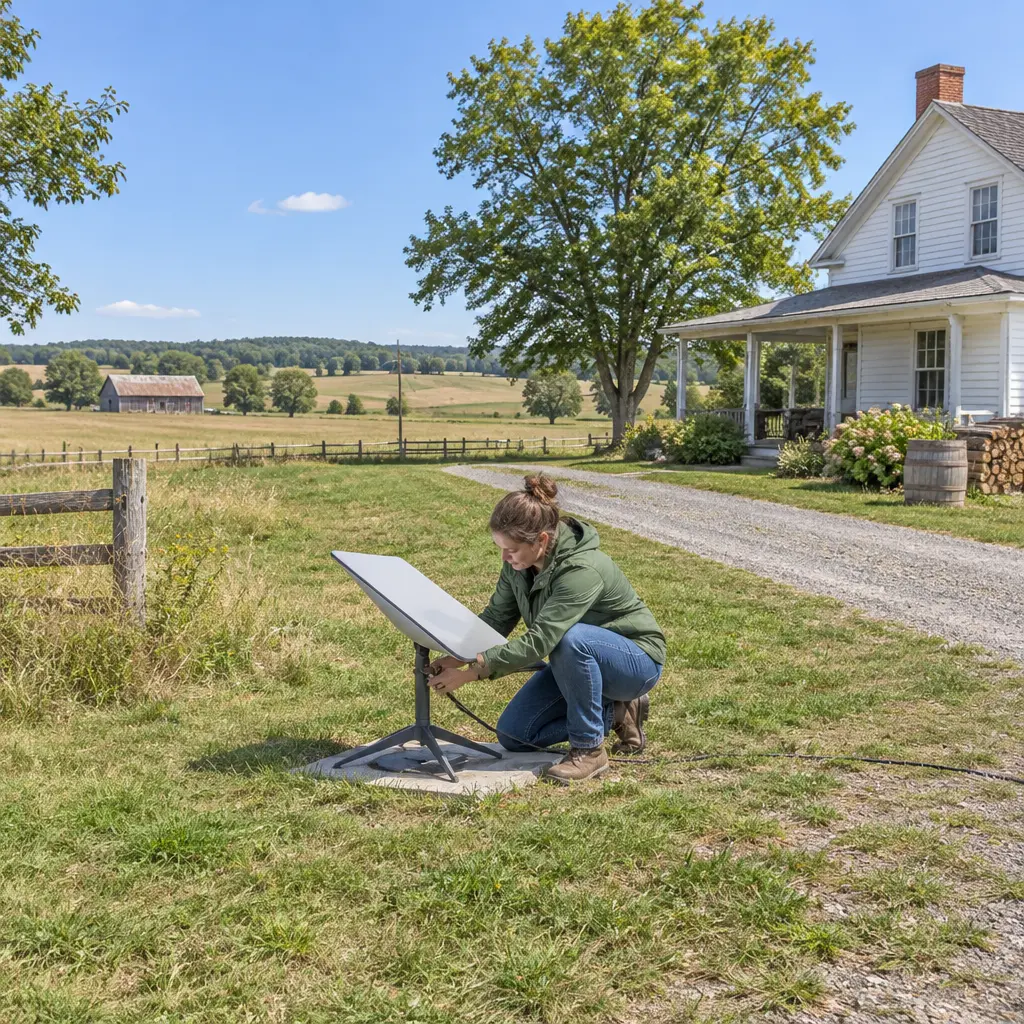
Low Earth orbit (LEO) satellite connectivity uses satellites orbiting relatively close to Earth to deliver internet access, including to places where terrestrial networks are costly or difficult to build. It can help narrow rural connectivity gaps, but it is not a stand-alone cure: affordability, capacity, installation, reliability, and local policy determine whether coverage becomes useful service. The International Telecommunication Union (ITU) estimated that 2.6 billion people remained offline in 2023, while the Federal Communications Commission (FCC) reported that 24 million people in the United States lacked access to fixed terrestrial broadband meeting its benchmark at the end of 2022. This article explains how LEO service works, where it fits alongside other rural technologies, what deployment examples show, and which measures can make it more inclusive.
LEO satellite connectivity bridges rural access gaps through orbital broadband
LEO satellite connectivity is broadband delivered through satellites in low Earth orbit, commonly a few hundred to roughly 2,000 kilometers above the surface. Unlike geostationary satellites, which orbit at about 35,786 kilometers and appear fixed over one point, LEO satellites move rapidly across the sky and hand connections between satellites and user terminals or gateways. The European Space Agency describes low Earth orbit as extending to approximately 2,000 kilometers; the lower altitude reduces signal travel time but requires many satellites and coordinated network operations to maintain service.
For rural communities, the principal advantage is geographic reach: a satellite link can serve a home, school, clinic, or business without waiting for a fiber route or mobile tower to be built nearby. Yet “available” does not automatically mean affordable, fast at busy times, or resilient in severe weather. The relevant outcome is meaningful connectivity: service that people can afford, use reliably, and access with suitable devices and digital skills.
Why rural connectivity remains difficult
Rural broadband economics are shaped by distance, terrain, population density, and the cost of backhaul. The U.S. Government Accountability Office has noted that providers may face higher per-customer deployment costs in remote areas because fewer subscribers share the expense of infrastructure. Mountains, forests, islands, and long distances can further complicate construction and maintenance.
The problem is global as well as local. The ITU’s 2023 estimate of 2.6 billion people offline includes people without network coverage and people who remain unconnected despite coverage because of cost, device access, skills, or other barriers. Satellite technology can address some coverage constraints, but it cannot by itself resolve all of these adoption barriers.
LEO compared with other satellite and terrestrial options
LEO is one part of a wider connectivity toolkit. Fiber can offer high capacity and low latency where construction is feasible. Fixed wireless can connect dispersed sites from a nearby tower. Mobile networks support users on the move, while geostationary satellite broadband can cover large areas using fewer spacecraft but generally has higher latency because signals travel farther.
The FCC’s broadband benchmark, updated in 2024, is 100 megabits per second downstream and 20 Mbps upstream for fixed broadband. That benchmark is a planning and measurement reference, not a guarantee that every household needs the same speed. LEO performance varies by provider, plan, terminal, weather, network congestion, and location; comparisons should therefore use measured service quality and total cost rather than advertised peak speeds alone.
LEO broadband performance depends on latency, capacity, and availability
Network performance is the combination of speed, latency, reliability, and capacity available to users. The National Telecommunications and Information Administration (NTIA) emphasizes that broadband quality is not captured by a single advertised download figure. For satellite systems, orbit height and network design influence latency, while the number of users sharing radio and gateway capacity affects real-world throughput.
Latency and interactive applications
Latency is the time data takes to travel between a user and an online destination. Lower latency generally improves video calls, remote desktop use, online learning, and interactive applications. Because LEO satellites are much closer to Earth than geostationary satellites, their paths can reduce propagation delay; however, routing, gateways, congestion, and the rest of the internet also contribute to the delay users experience.
Latency claims should be assessed using independent measurements over time, not only provider specifications. A useful evaluation records typical and peak-hour latency, packet loss, upload and download speeds, and interruptions at the actual service address.
Capacity, congestion, and service consistency
Capacity is the amount of data a network can carry for users in a given area and period. A satellite may cover a broad region, but the bandwidth available to each subscriber is shared and constrained by spectrum, satellite beams, gateway links, and the number of customers online. Thus, coverage maps do not reveal how a service will perform during evening peaks or after rapid customer growth.
Publicly available speed tests can help compare performance, but results should be interpreted carefully: samples may be unevenly distributed and may not represent every rural community. Regulators and funders can improve accountability by requiring transparent reporting of location-specific availability, measured speeds, outages, and service-plan changes.
Weather, obstruction, and power resilience
Availability describes whether a connection can be used when needed, not merely whether a satellite passes overhead. Heavy rain or snow can weaken some satellite signals, and trees, buildings, or terrain can obstruct a terminal’s view of the sky. Equipment also requires electricity, so outages can disconnect a satellite customer unless backup power is available.
Before installation, households and community facilities should check the intended terminal location for a clear sky view and plan for mounting, cabling, power, and safe maintenance. Clinics, emergency centers, and schools may need battery or generator backup and a secondary connection where continuous service is essential.
Rural LEO deployment succeeds when access includes affordability and support
Digital inclusion means that people can obtain and effectively use connectivity, not simply that a network reaches their region. The U.S. National Digital Inclusion Alliance describes digital inclusion as equitable access to affordable, robust broadband, internet-enabled devices, digital skills training, and technical support. This broader definition helps explain why a satellite terminal alone may not close a rural digital divide.
Affordability and the full cost of service
The total cost of satellite broadband can include a monthly subscription, a terminal and mounting equipment, shipping, installation, taxes, and replacement or repair. These expenses can be prohibitive for low-income households even where service is technically available. The ITU has repeatedly identified affordability as a key factor in internet adoption, particularly in lower-income countries.
Public programs should compare the complete cost of ownership with household incomes and alternative technologies. Options include targeted equipment grants, community purchasing, subsidies for eligible households, and public access points. Any subsidy should be designed around actual service use and should avoid locking communities into a single provider when alternatives become available.
Schools, clinics, farms, and community anchor institutions
A community anchor institution is a school, library, health facility, or similar organization that can support connectivity beyond its own premises. A satellite connection may provide backhaul for a rural school or clinic, or serve as a temporary link while fiber or terrestrial wireless infrastructure is built. Shared access points can extend benefits to residents who cannot afford a household subscription.
In agriculture, internet access can support weather information, market data, equipment monitoring, and precision-farming tools. In health care, it can enable telehealth visits and access to digital records, subject to privacy, clinical, and reliability requirements. These applications depend on local training, suitable devices, and dependable upstream capacity—not just a nominal connection.
Local installation, digital skills, and accountability
Community-based support helps translate coverage into adoption. Local technicians can install terminals, troubleshoot obstructions, explain billing, and help users protect accounts and personal information. Libraries and schools can provide digital-skills support and identify residents who need accessible devices or language assistance.
A responsible deployment should track more than the number of terminals shipped. Useful measures include the share of households that activate service, monthly affordability, service quality at peak times, outage duration, customer-support response, and participation among underserved groups. Reporting should protect subscriber privacy and make results understandable to residents and funders.
LEO rural connectivity requires sound policy and complementary networks
Broadband policy determines how satellite service fits into long-term rural infrastructure plans. The FCC’s 2024 broadband availability report and the U.S. Department of Agriculture’s ReConnect program illustrate the roles of mapping, grants, and deployment standards in identifying underserved areas and financing network construction. Public decisions should compare technologies neutrally and ensure that funded service meets defined performance and affordability requirements.
Use LEO as a bridge, backhaul, or permanent option
LEO can serve as a bridge where terrestrial construction is delayed, as backhaul for a remote community network, or as a long-term option for isolated locations where building fiber is not economically or geographically practical. These roles are not mutually exclusive. A community can use satellite service now while planning fiber, fixed wireless, or mobile expansion over time.
Technology-neutral planning compares the cost per served household, installation timeline, expected lifespan, upgrade path, resilience, and operating expenses of each feasible option. It also avoids treating a temporary emergency connection as an adequate permanent solution without transparent evidence that the service meets community needs.
Spectrum, competition, and orbital sustainability
Satellite services depend on access to radio spectrum and coordination to limit harmful interference between systems. National regulators and the International Telecommunication Union manage spectrum and orbital filings, while operators must coordinate with other satellite and terrestrial users. Competition can offer consumers more choice, but oversight is needed to support fair access, clear service terms, and effective consumer protections.
The growing number of satellites also raises concerns about orbital debris, collision risk, and impacts on astronomical observations. The U.S. Government Accountability Office has identified space traffic management and debris mitigation as important issues as commercial activity expands. Sustainable deployment therefore requires responsible spacecraft design, collision-avoidance practices, end-of-life disposal, and coordination among operators and regulators.
Real-world deployment lessons
In the United States, the FCC’s Rural Digital Opportunity Fund was created to support broadband deployment in underserved areas using a competitive process that included satellite providers. The program’s experience underlines the importance of verifying provider capacity, scrutinizing coverage claims, and linking public support to enforceable buildout and performance obligations.
Internationally, the World Bank’s Digital Development work has documented the potential of satellite connectivity to reach remote and hard-to-serve populations, while emphasizing that infrastructure must be paired with affordability, competition, and digital skills. These examples point to a consistent lesson: LEO is most effective when it complements terrestrial investment and is integrated into a local plan for access, support, and measurable outcomes.
Conclusion: LEO connectivity can narrow, but not erase, rural digital divides
LEO satellite connectivity can extend broadband to rural homes and institutions where terrestrial networks are difficult to deploy. Its lower orbital altitude can improve latency relative to geostationary service, but performance still depends on capacity, obstruction, weather, power, and local network conditions. As the ITU’s estimate of 2.6 billion people offline and the FCC’s rural access findings make clear, the connectivity challenge is large and multidimensional.
Bridging the divide requires treating satellite coverage as one component of meaningful connectivity. Policymakers, providers, and community organizations should evaluate affordability, measured performance, installation and support, resilience, competition, and long-term sustainability alongside coverage maps. Communities planning projects can begin by mapping unmet needs, comparing LEO with fiber and wireless alternatives, consulting residents and anchor institutions, and publishing clear performance and affordability measures.
Further reading should include the ITU’s connectivity statistics, FCC broadband availability and performance materials, NTIA broadband guidance, and the World Bank’s digital development resources. Together, these sources help communities assess where LEO is a practical bridge, where it can provide lasting service, and what complementary investments are needed to ensure no one is left offline.
Sources: International Telecommunication Union, Facts and Figures 2023, https://www.itu.int/itu-d/reports/statistics/facts-figures-2023/; Federal Communications Commission, 2024 Section 706 Report, https://www.fcc.gov/reports-research/reports/broadband-progress-reports/2024-broadband-deployment-report; European Space Agency, Types of Orbits, https://www.esa.int/Enabling_Support/Space_Transportation/Types_of_orbits; National Telecommunications and Information Administration, National Broadband Availability Map, https://broadbandusa.ntia.gov/resources/data-and-mapping; National Digital Inclusion Alliance, Definitions, https://www.digitalinclusion.org/definitions/; U.S. Government Accountability Office, Broadband: FCC Should Improve Performance Goals and Measures for Its Rural Broadband Program, https://www.gao.gov/products/gao-23-105711; U.S. Department of Agriculture, ReConnect Loan and Grant Program, https://www.usda.gov/reconnect; World Bank, Digital Development, https://www.worldbank.org/en/topic/digitaldevelopment; U.S. Government Accountability Office, Large Constellations of Satellites: Mitigating Environmental and Other Effects, https://www.gao.gov/products/gao-23-105005.